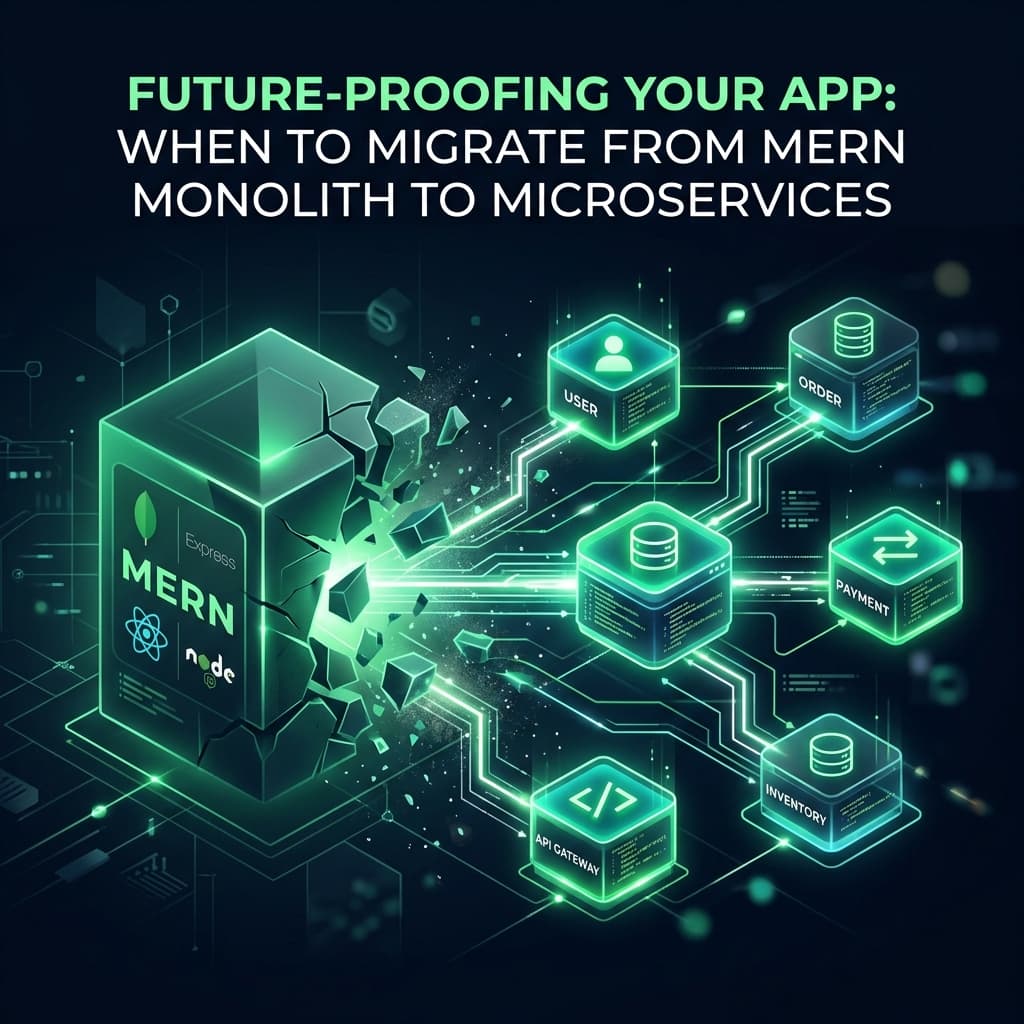
Future-Proofing Your App: When to Migrate from MERN Monolith to Microservices

Written by
Bhalli B
Full-Stack Engineer & SaaS MVP Architect
Certified Full-Stack Developer & MVP Specialist · Lahore, Pakistan
If your startup is struggling with scaling bottlenecks, the absolute worst move you can make is a premature migration to microservices.
You should only migrate from a MERN (MongoDB, Express, React, Node.js) monolith to microservices when you hit three specific tipping points: your engineering team exceeds 25-30 developers, feature delivery is paralyzed by deployment coordination queues, or a single intensive sub-system (such as background data processing) starves the rest of your app's compute resources.
If you do not meet these organizational and technical thresholds, a distributed architecture will decrease your development speed and drastically inflate your cloud hosting invoices. Instead, your intermediate target should be a Modular Monolith.
This guide outlines a transition blueprint designed by a senior developer and project manager, walking you through the exact technical migration steps, real-world cost trade-offs, and risk-mitigated coding patterns using Node.js, Express, and Next.js.
1. The Architectural Trap: Why Startups Fail by Moving Too Fast
Many startup founders and technical leaders view microservices as a milestone of engineering maturity. They assume that splitting an application into independent services will magically resolve slow load times, messy codebases, and developer friction.
In reality, migrating premature monoliths into microservices is one of the most common causes of startup architecture failures. It often produces a distributed monolith: a system with all the networking overhead, latency, and operational complexity of distributed environments, but none of the scaling benefits.
In a traditional MERN monolith, in-process function execution occurs in microseconds. The moment you split those modules into separate servers, every cross-boundary function call becomes an HTTP REST or gRPC request traveling over a network.
If your backend services are highly coupled, a single user request can trigger a cascade of synchronous internal calls, compounding latency mathematically:
Without proper queueing, caching, and service boundaries, your application's $p99$ response times will spike, dragging down user experience and search engine index scores.
The Human Cost: Conway's Law
From a project management standpoint, architecture mirrors organization. Conway’s Law states:
"Organizations which design systems are constrained to produce designs which are copies of the communication structures of these organizations."
If you have a small engineering team (under 15 developers), splitting your code into ten repositories requires them to constantly switch contexts, configure multiple CI/CD pipelines, and coordinate API contracts.
Instead of writing product features, your engineering hours are spent managing cloud infrastructure and debugging distributed network failures.
2. Long-Tail Search Intent: How Do I Know My MERN Monolith Needs Splitting?
Instead of guessing, use quantitative and qualitative metrics to determine if a migration is justified. If your metrics are stable, stay monolithic but transition to a Modular Monolith—organizing your Express backend around clean, logically isolated modules inside a single codebase.
Three Unmistakable Migration Signals
- Skewed Resource Allocation Metrics: In a MERN app, your backend runs inside a single Node.js runtime container. If a resource-heavy feature—such as dynamic PDF generation or parsing massive uploads—experiences a traffic spike, it can consume the Event Loop. This starves simple API requests (like fetching a user profile), causing your entire application to become slow or unresponsive. If your core user-facing API performance is degraded by a single resource-intensive backend endpoint, it's time to extract that specific module into an independent, autoscaling service.
- The Deployment Bottleneck: If your developers must wait in virtual "queues" to merge code, or if a single bug in the analytics module blocks a critical billing patch from going live, your deployment cycle is too tightly coupled. When coordination overhead begins to block feature velocity, separating high-change domains from low-change domains into separate deployable units becomes a viable strategy.
- Organizational Team Splits: If your engineering team is expanding and you want to organize them into independent product groups (e.g., dedicated checkout, catalog, and support teams), keeping everyone in a single database schema creates data-coupling issues. You can assign complete ownership of specific microservices to distinct, cross-functional teams, allowing them to ship code independently.
| Metric Dimension | Monolith / Modular Monolith | Microservices Destination |
|---|---|---|
| Team Size | 1 to 20 Developers | 25+ Developers structured in pods |
| Code Isolation | Logical boundaries inside one repo | Physical boundaries across repos |
| Database Strategy | Single shared MongoDB database | Database-per-service (Separate DBs/schemas) |
| Deployment Risk | Single deployment, high coordination | Independent deployments, zero-downtime |
| Operational Overhead | Low (Standard serverless / VPS setup) | High (API Gateway, tracing, container orchestration) |
3. The Step-by-Step Strangler Fig Migration Strategy for MERN Stack
Never attempt a "big bang" rewrite where you halt feature development for six months to build a microservices platform from scratch. This approach is a common pitfall that often fails due to shifting business requirements, lack of ongoing validation, and team fatigue.
Instead, employ the Strangler Fig Pattern. This strategy focuses on incrementally extracting self-contained domains from the monolith into independent microservices, utilizing an API gateway or router to seamlessly proxy traffic between the old and new systems.
Strangler Fig Migration Flow
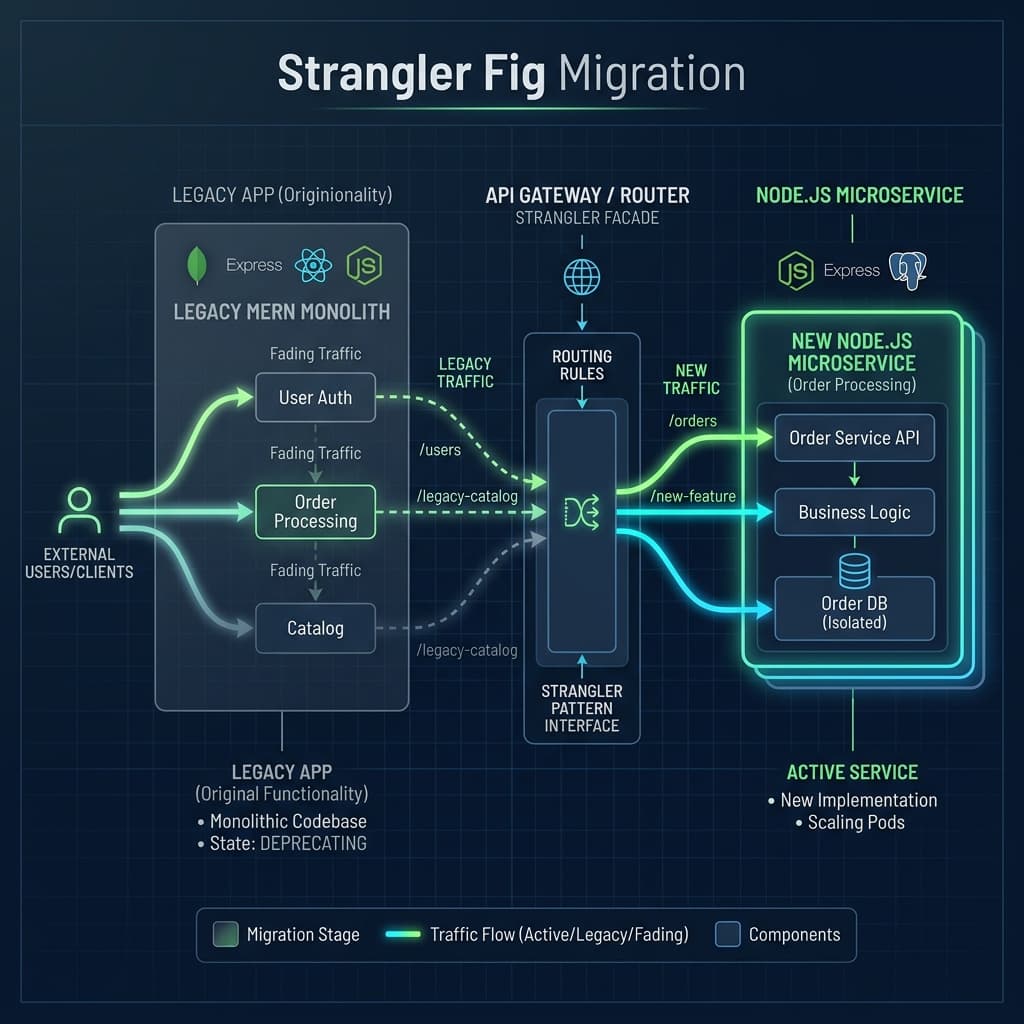 Figure 1: Architectural map of the Strangler Fig migration pattern routing API routes through an edge gateway to legacy and extracted systems.
Phase 1: Establish Logical Module Boundaries (The Modular Monolith First)
Before you physically extract any code, you must first decouple your code inside the monolith. Introduce strict service boundaries and eliminate direct database joins or cross-module database operations.
Let's look at how to implement strict repository boundaries in an Express/TypeScript codebase to prevent your business logic from directly querying tightly coupled models.
// src/modules/orders/domain/order.repository.ts
// Port definition: Establishes a strict abstraction boundary
export interface IOrderRepository {
  create(order: any): Promise<any>;
  findById(id: string): Promise<any | null>;
}

// src/modules/orders/infrastructure/mongodb-order.repository.ts
// Adapter implementation: Encapsulates MongoDB/Mongoose logic safely
import { IOrderRepository } from '../domain/order.repository';
import mongoose from 'mongoose';

const OrderSchema = new mongoose.Schema({
  customerId: { type: String, required: true },
  items: Array,
  totalAmount: Number,
  createdAt: { type: Date, default: Date.now }
});

const OrderModel = mongoose.models.Order || mongoose.model('Order', OrderSchema);

export class MongoDbOrderRepository implements IOrderRepository {
  async create(order: any): Promise<any> {
    const doc = await OrderModel.create(order);
    return doc.toObject();
  }

  async findById(id: string): Promise<any | null> {
    const doc = await OrderModel.findById(id).lean();
    return doc || null;
  }
}
By decoupling database-specific ORM interactions via interfaces, you ensure that when the Orders module is physically extracted into a separate container, the business logic consuming IOrderRepository remains completely unchanged. You will simply write a new implementation of IOrderRepository that communicates over HTTP/gRPC with the new microservice.
Phase 2: Create a Strangler API Gateway with Next.js Edge Middleware
The API gateway acts as an traffic router, intercepting requests and routing them to either the legacy MERN server or the newly extracted microservices based on path prefixes.
If your frontend is built with Next.js, you can leverage Next.js Edge Middleware as a highly performant API gateway that runs globally, routing traffic closer to your users without cold starts.
// middleware.ts
// High-performance traffic router implementing the Strangler Fig Pattern at the Edge
import { NextResponse } from 'next/server';
import type { NextRequest } from 'next/server';

// Define endpoints that have been fully migrated to independent microservices
const DECOUPLED_SERVICES: Record<string, string> = {
  '/api/orders': process.env.ORDERS_MICROSERVICE_URL || 'https://orders-service.production.internal',
  '/api/payments': process.env.PAYMENTS_MICROSERVICE_URL || 'https://payments-service.production.internal',
};

const MONOLITH_ORIGIN = process.env.LEGACY_MONOLITH_URL || 'https://api-monolith.production.internal';

export function middleware(request: NextRequest) {
  const { pathname, search } = request.nextUrl;

  // Intercept backend API requests
  if (pathname.startsWith('/api/')) {
    // Find if the path prefix matches an extracted microservice route
    const matchedPrefix = Object.keys(DECOUPLED_SERVICES).find((prefix) =>
      pathname.startsWith(prefix)
    );

    const targetOrigin = matchedPrefix ? DECOUPLED_SERVICES[matchedPrefix] : MONOLITH_ORIGIN;
    const targetUrl = new URL(pathname + search, targetOrigin);

    // Propagate request context, client IP, and traces for distributed observability
    const requestHeaders = new Headers(request.headers);
    requestHeaders.set('x-forwarded-for', request.ip ?? '127.0.0.1');
    requestHeaders.set('x-request-id', crypto.randomUUID());

    // Rewrite the request destination at the edge node
    return NextResponse.rewrite(targetUrl, {
      request: {
        headers: requestHeaders,
      },
    });
  }

  return NextResponse.next();
}

export const config = {
  matcher: ['/api/:path*'],
};
4. Decoupling the Monolithic MongoDB Database: The Hardest Part
In a traditional MERN monolith, developers often execute queries that join collections across domain boundaries (e.g., retrieving an order and joining it with product catalogs and customer records in a single Mongoose lookup).
When you migrate to microservices, you must transition to a database-per-service pattern. A service should never directly access the data store of another service.
Database Coupling Architectures
❌ UNHEALTHY COUPLING (Distributed Monolith)
Multiple independent services directly query and join tables in a single shared database instance.
Risk: Database schema changes in one service crash the other. Cascading connection bottlenecks disrupt the entire platform.
✅ HEALTHY DECOUPLING (Database-per-Service)
Each service has complete ownership over its own isolated database. Cross-service data is synced asynchronously.
Benefit: Services are fully isolated, schema migrations are completely independent, and databases scale to zero individually.
Strategy for Seamless Data Split
- Step 1: Establish logical isolation first: Keep data in the same MongoDB instance, but separate the database into independent schemas, logically eliminating crossing operations.
- Step 2: Establish data projections (Read-Only Views): If the Orders service needs customer name verification, do not execute a synchronous REST lookup to the Users service on every order query. Instead, build a read-only projection of the user data inside the Orders database.
- Step 3: Implement Event-Driven Sync: When a profile is updated in the Users service, publish a lightweight message to a reliable broker (such as RabbitMQ or Apache Kafka). The Orders service subscribes to these events and updates its user projection, ensuring eventual consistency asynchronously:
  ┌─────────────────┐                  ┌─────────────────┐
  │  User Service   │                  │  Order Service  │
  └────────┬────────┘                  └────────┬────────┘
           │ (Publish Event)                    ▲ (Consume & Sync)
           ▼                                    │
    [ Message Queue (RabbitMQ / Event Bus) ] ───┘
5. Human Project Management Insights: Balancing Technical Debt with Delivery Speed
As a Certified Project Manager, I must caution against ignoring the operational overhead of microservices. Decoupled systems introduce significant complexity across your delivery pipeline:
- Observability Cost: Finding bugs across distributed services is significantly more difficult than diagnosing a single stack trace. You will need to invest in distributed request tracking tools, structured error capture configurations, and centralized logging platforms.
- Testing Friction: You can no longer rely on simple system-wide integration tests. You must adopt contract testing frameworks (like Pact) to ensure that updates made to one service's API do not break down dependency operations elsewhere in production.
- Operational Expenses (OpEx): While serverless solutions (like Next.js on Vercel and serverless databases) can scale to zero during development, running multiple microservice containers on Kubernetes, ECS, or dedicated VPS nodes will increase your cloud hosting bills.
The Recommended Hybrid Roadmap
If you are currently running a scaling MERN app, follow this structured roadmap over a 3-to-6-month window to minimize operational risks:
- Months 1-2: Domain Analysis & Modularization: Refactor your existing Express codebase into self-contained directories. Enforce absolute interface boundaries between those directories. Completely eliminate cross-domain database relationships and direct multi-schema queries.
- Month 3: API Gateway Implementation & Infrastructure Setup: Set up your edge router (e.g., Next.js middleware) and create the deployment environments for your first candidate microservice.
- Month 4: Extract the First "Low-Risk, High-Gain" Module: Extract a clean, highly cohesive service (such as transactional email queues, image generation, or report exports).
- Months 5-6: Shadow Traffic & Cutover: Route a small fraction of real production traffic to the new service using shadow writes or feature flags. Validate parity in performance and data integrity before deprecating the old monolithic pathways.
6. Conclusion & Actionable Roadmap
Transitioning your application from a MERN monolith to microservices is not an all-or-nothing decision. By modernizing your backend code into structured modules, introducing clean boundary interfaces, and strategically routing traffic using Next.js Edge patterns, you can optimize your application's scalability and responsiveness while avoiding premature architectural complexity.
Scale Your Architecture: Let's discuss your current system design. Book a 1-on-1 Architectural Audit to identify bottlenecks, define clean domain boundaries, and map out a risk-free scaling roadmap.