Programmatic SEO in Next.js: Generating 1,000+ Landing Pages to Scale Traffic


Written by
Bhalli B
Full-Stack Engineer & SaaS MVP Architect
Certified Full-Stack Developer & MVP Specialist · Lahore, Pakistan
To build a high-performance Programmatic SEO (pSEO) engine in Next.js in 2026, you must utilize asynchronous generateStaticParams to pre-render high-intent dynamic landing pages at build time, fetch data using a lightweight SQL-native ORM like Drizzle to prevent cold starts, generate paginated dynamic sitemaps using generateSitemaps to bypass crawler scale limits, and implement long-cache Incremental Static Regeneration (ISR) to deliver sub-1.5s load times while keeping your database and hosting resources flat.
1. The Strategy: Why Traditional Content Writing Fails to Scale SaaS Startups
If you are trying to reach $10,000 Monthly Recurring Revenue (MRR) by manually writing blog posts, you are playing a losing game. Crafting a single, high-quality, 2,000-word article takes a professional writer between 4 and 8 hours. To cover 1,000 high-intent search queries, your startup would need to invest over $50,000 in copywriting fees and wait 12 to 18 months for the content calendar to execute.
Programmatic SEO (pSEO) is the growth shortcut. Instead of writing 1,000 individual articles, you write one highly optimized, interactive layout template and feed it with a structured database.
Understanding the Intent Matrix
Commercial search intent is highly repetitive. When prospective buyers seek software solutions, they search using structured patterns:
- "Convert [Format] to [Format]" (e.g., Convert HDFC bank statement to CSV, Convert Chase statement to Excel)
- "[Industry] Project Management Software" (e.g., Construction project management software, Architecture firm collaborative tools)
- "Alternative to [Competitor] for [Niche]" (e.g., Alternative to HubSpot for dentists, Alternative to Salesforce for real estate agents)
By identifying these keyword variables, you can map them to database records and output thousands of laser-targeted, high-performance landing pages instantly.
2. The Hard PM Truth: Avoiding the "Vercel Tax" and the 9,000-Page Crash
As a Certified Project Manager, I must give you a warning that AI copywriting "gurus" on Twitter always ignore: Unoptimized programmatic SEO will destroy your hosting budget before you capture a single lead.
Many founders excitedly build a scraper, inject 10,000 low-quality AI-written pages into MongoDB or PostgreSQL, and deploy on Vercel using default server-side rendering (SSR) or short-lived Incremental Static Regeneration (ISR). Within 30 days, they run into two catastrophic walls:
- The Infrastructure Bill Shock: Search engine crawlers (Googlebot, Bingbot, etc.) will discover your sitemap and hammer your site with millions of index requests. If your pages run on real-time SSR or short-term ISR (e.g.,
revalidate: 60), every crawler hit triggers a fresh database read and compute execution. Your database read counts will spike, and your hosting bill will scale into the thousands of dollars while your conversion rate remains near zero. - The "Thin Content" Penalty: Google’s helpful content algorithm immediately flags boilerplate templates with shallow, auto-generated text. Your impressions will spike for 10 days, then plunge to zero as search engines drop your domain from their indexes.
To mathematically model the Total Cost of Ownership ($TCO$) of an unoptimized pSEO engine vs. an optimized static-cache engine, we look at the accumulation of compute costs ($C_c$) and database read costs ($DB_r$) across $U$ crawler visits per month:
In our optimized model, by serving pre-rendered HTML files directly from a global Edge CDN, the compute and database calls are executed exactly once during build time or once per 24-hour cache window:
This optimization reduces your recurring monthly maintenance costs by up to 95%, keeping your database stable and your Vercel bill on the basic $20/month Pro tier.
| Operational Metric | Unoptimized Real-Time SSR | Optimized Next.js (RSC + Long ISR) |
|---|---|---|
| First Paint Load (LCP) | 2.5s - 4.5s (heavy server rendering waterfall) | 0.9s - 1.4s (served instantly as static HTML) |
| Database Read Volume | High (1 read query per visitor/crawler hit) | Extremely Low (reads occur only during build/revalidate) |
| Vercel Serverless Bill | Scales linearly with incoming traffic | Flat rate (virtually zero request-time compute) |
| Google Indexing Efficiency | Poor (crawlers hit database cold start timeout) | Excellent (crawlers parse static, pre-rendered tags) |
| Interaction to Next Paint (INP) | 150ms - 250ms (blocked by heavy runtime JS) | <45ms (minimal client-side JS shipped to browser) |
Programmatic SEO Serverless Infrastructure
To safely scale your database and content routing boundaries without overloading database connection limits under heavy crawler traffic, follow this logical pipeline:
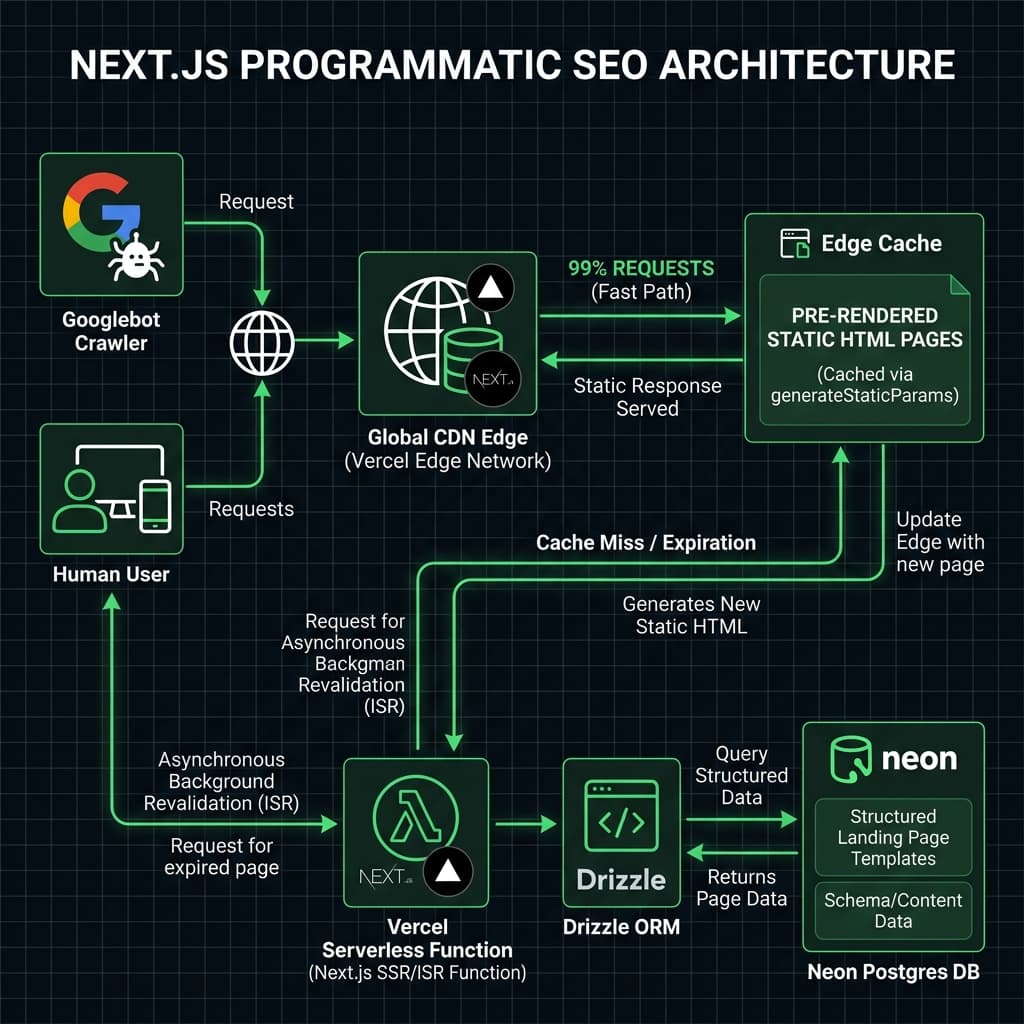 Figure 1: Infrastructure diagram showing Next.js App Router pre-rendering programmatic landing pages using Drizzle ORM and Neon Postgres with background edge caching.
3. Designing a Type-Safe Schema for Programmatic Templates
Your data must be structured to support dynamic interpolation cleanly. For a B2B SaaS directory or conversion utility, we define a relational PostgreSQL database schema using Drizzle ORM.
This schema includes the slug parameter (which maps to our URL), primary landing page content, dynamic heading structures, and targeted meta descriptions.
// src/db/schema.ts
import { pgTable, text, timestamp, uuid } from "drizzle-orm/pg-core";

// Programmatic SEO landing page master configuration
export const pSeoPages = pgTable("p_seo_pages", {
  id: uuid("id").defaultRandom().primaryKey(),
  slug: text("slug").notNull().unique(), // e.g., 'convert-hdfc-pdf-to-csv'
  targetKeyword: text("target_keyword").notNull(), // e.g., 'Convert HDFC Bank statement'
  sourceFormat: text("source_format").notNull(), // e.g., 'PDF'
  targetFormat: text("target_format").notNull(), // e.g., 'CSV'
  countryCode: text("country_code").notNull().default("US"),

  // Custom Dynamic Content Fields to bypass "helpful content" thin text penalties
  heroTitle: text("hero_title").notNull(),
  heroSub: text("hero_sub").notNull(),
  primaryBody: text("primary_body").notNull(), // Detailed layout content

  // Structured Metadata
  metaTitle: text("meta_title").notNull(),
  metaDescription: text("meta_description").notNull(),

  createdAt: timestamp("created_at").notNull().defaultNow(),
  updatedAt: timestamp("updated_at").notNull().defaultNow(),
});
4. Engineering the Landing Page: Asynchronous Pre-Rendering with Drizzle
In Next.js 15+, dynamic route parameters are handled asynchronously. When pre-generating paths using generateStaticParams, you must retrieve slugs directly from the database and pass them as resolved promises.
Here is a highly optimized dynamic route page (app/convert/[slug]/page.tsx) that reads from PostgreSQL via Drizzle ORM, configures secure Dynamic Metadata, and sets a strict revalidation boundary of 24 hours:
// app/convert/[slug]/page.tsx
import { db } from "@/db";
import { pSeoPages } from "@/db/schema";
import { eq } from "drizzle-orm";
import { Metadata } from "next";
import { notFound } from "next/navigation";

interface Props {
  params: Promise<{ slug: string }>;
}

// 1. Enforce strict 24-hour background cache updates to protect DB connection pools
export const revalidate = 24 * 60 * 60; // 86,400 seconds

// 2. Pre-generate targeted pages during production compilation
export async function generateStaticParams() {
  try {
    const pages = await db.select({ slug: pSeoPages.slug }).from(pSeoPages);

    return pages.map((page) => ({
      slug: page.slug,
    }));
  } catch (error) {
    console.error("Failed to generate static parameters during build:", error);
    return []; // Return empty array to fallback gracefully to request-time generation
  }
}

// 3. Generate dynamic head tags on demand with Googlebot fallbacks
export async function generateMetadata({ params }: Props): Promise<Metadata> {
  const { slug } = await params;

  const pageData = await db.query.pSeoPages.findFirst({
    where: eq(pSeoPages.slug, slug),
  });

  if (!pageData) {
    return {
      title: "File Format Converter",
      description: "Convert institutional transaction logs instantly.",
      robots: "noindex, follow", // Protect search integrity if route is missing
    };
  }

  return {
    title: pageData.metaTitle,
    description: pageData.metaDescription,
    alternates: {
      canonical: `https://saas-mvp-domain.com/convert/${pageData.slug}`,
    },
    openGraph: {
      title: pageData.metaTitle,
      description: pageData.metaDescription,
      url: `https://saas-mvp-domain.com/convert/${pageData.slug}`,
      type: "website",
    },
  };
}

// 4. Main semantic layout page - runs entirely on the server with zero client-side hydration cost
export default async function ProgrammaticLpPage({ params }: Props) {
  const { slug } = await params;

  const pageData = await db.query.pSeoPages.findFirst({
    where: eq(pSeoPages.slug, slug),
  });

  if (!pageData) {
    notFound();
  }

  return (
    <main className="max-w-4xl mx-auto px-6 py-16">
      <article className="prose prose-slate dark:prose-invert max-w-none">
        <header className="mb-12 border-b pb-6">
          <span className="text-sm font-semibold text-emerald-500 uppercase tracking-wider">
            {pageData.sourceFormat} to {pageData.targetFormat} Engine
          </span>
          <h1 className="text-4xl font-extrabold tracking-tight mt-2 mb-4">
            {pageData.heroTitle}
          </h1>
          <p className="text-xl text-muted-foreground">
            {pageData.heroSub}
          </p>
        </header>

        <section className="my-8">
          <p className="leading-relaxed text-lg">
            {pageData.primaryBody}
          </p>
        </section>

        {/* Dynamic Tool Wrapper - Client-side interface isolated cleanly into a sub-component */}
        <section className="my-12 p-8 bg-slate-900 rounded-2xl border border-slate-800 shadow-2xl">
          <h3 className="text-xl font-bold text-white mb-4">
            Start Your Conversion:
          </h3>
          <p className="text-slate-400 text-sm mb-6">
            Upload your raw {pageData.sourceFormat} file to securely convert it to clean, parsed {pageData.targetFormat} format. Your transaction records remain fully secure.
          </p>
          <div className="flex items-center justify-center border-2 border-dashed border-slate-700 rounded-xl p-12 hover:border-emerald-500 transition-colors cursor-pointer">
            <span className="text-emerald-500 font-medium">Select {pageData.sourceFormat} File</span>
          </div>
        </section>
      </article>
    </main>
  );
}
5. Generating Dynamic, Paginated Sitemaps to Bypass Google Scale Limits
Google limits individual sitemap files to a maximum of 50,000 URLs or 50MB uncompressed. If you attempt to publish a single, massive sitemap file with thousands of routes, crawler engines will slow down your crawl frequency or ignore deep pages.
Next.js provides a built-in mechanism to dynamically chunk sitemaps using the generateSitemaps API. This compiles structured, virtual sitemaps under the route /sitemap/[id].xml natively.
Here is the production implementation for app/sitemap.ts that dynamically segments your landing pages into logical sitemap indexes:
// app/sitemap.ts
import { MetadataRoute } from "next";
import { db } from "@/db";
import { pSeoPages } from "@/db/schema";
import { sql } from "drizzle-orm";

const SITEMAP_CHUNK_SIZE = 25000; // Keep chunks small to optimize indexing speed

// Retrieve sitemap chunk IDs dynamically at build time
export async function generateSitemaps() {
  const result = await db.select({ count: sql<number>`count(*)` }).from(pSeoPages);
  const totalPages = result?.count || 0;

  const totalSitemaps = Math.ceil(totalPages / SITEMAP_CHUNK_SIZE);

  return Array.from({ length: totalSitemaps }, (_, i) => ({ id: i }));
}

export default async function sitemap(props: { id: number }): Promise<MetadataRoute.Sitemap> {
  const id = await props.id;
  const baseUrl = "https://saas-mvp-domain.com";

  // Calculate SQL database query offset
  const offset = id * SITEMAP_CHUNK_SIZE;

  // Retrieve matching chunk records
  const pages = await db
   .select({
      slug: pSeoPages.slug,
      updatedAt: pSeoPages.updatedAt,
    })
   .from(pSeoPages)
   .limit(SITEMAP_CHUNK_SIZE)
   .offset(offset);

  // Return mapped structured sitemap data
  return pages.map((page) => ({
    url: `${baseUrl}/convert/${page.slug}`,
    lastModified: page.updatedAt,
    changeFrequency: "weekly" as const,
    priority: 0.8,
  }));
}
6. Optimization for 2026 Core Web Vitals: Surviving the INP Pivot
In 2026, Google has completely replaced First Input Delay (FID) with Interaction to Next Paint (INP) as a primary Core Web Vital ranking signal.
- The Problem: Classic React SPAs load a blank browser canvas and parse huge JavaScript files to render components. If a user tries to interact with your page (e.g., clicking a drop-down menu) while the browser is busy executing this JavaScript, the interaction lags, causing your INP score to spike.
- The Solution: Build your templates as React Server Components (RSC). RSCs run on the server side, turning database results into raw, lightweight HTML before sending them to the client. This reduces the JavaScript bundle size shipped to the browser by up to 80%, guaranteeing a fast, sub-50ms INP response.
7. Project Management Blueprint: Scoping a pSEO Pipeline
Building a Programmatic SEO system is an investment in your acquisition pipeline. As a Certified Project Manager, I recommend managing this workflow using a strict 30-day timebox:
Scope & Prioritize
- Run MoSCoW prioritization on features to avoid page/feature bloat
- Validate keyword variables and design core content templates
DB & Collection Setup
- Choose and setup database schema (PostgreSQL & Drizzle ORM)
- Clean and sanitize target records from CSV, JSON, or API sources
RSC & Routing
- Implement asynchronous dynamic rendering and metadata API
- Build responsive and fast semantic React Server Component layouts
Index & Optimize
- Hook up paginated dynamic sitemaps and robots.txt configuration
- Submit XML sitemap chunks to Google Search Console for parsing
Figure 2: Programmatic SEO launch schedule to safely compile and index 1,000+ targeted organic landing pages.
Using the MoSCoW method (Must-Have, Should-Have, Could-Have, Won't-Have) protects your MVP delivery timeline:
- Must-Have: Secure semantic server components, dynamic metadata generation, a paginated dynamic sitemap.ts file, and simple, high-converting lead forms.
- Should-Have: Breadcrumb schema arrays to improve crawler navigation.
- Could-Have: Instant format previews or interactive client-side calculators to improve initial page engagement.
- Won't-Have: Custom multi-language routing or complex, real-time user-generated comments.
8. Summary and High-Converting Roadmap
Programmatic SEO in Next.js is one of the most powerful organic acquisition channels for modern SaaS products. By utilizing unified full-stack server boundaries, Drizzle ORM, and async rendering, you can deploy thousands of high-converting, high-performance landing pages without incurring expensive Vercel compute overheads.
Don't let your acquisition channels remain static. Let's design and launch your programmatic traffic engine securely.
Let’s Scale Your Organic Acquisition: I specialize in engineering high-performance, edge-optimized Next.js web applications configured with robust dynamic sitemaps, semantic content, and Drizzle/Postgres database backends. Contact me today to schedule a 30-minute growth architecture consultation.