MongoDB Schema Design Patterns for B2B SaaS Startups


Written by
Bhalli B
Full-Stack Engineer & SaaS MVP Architect
Certified Full-Stack Developer & MVP Specialist · Lahore, Pakistan
A B2B SaaS schema that runs fine with three pilot customers can silently create a cross-tenant data leak at customer fifty, and it's almost never the auth layer or the encryption at rest that's the weak point - it's the tenant-isolation model baked into the collection design itself. MongoDB gives you three structurally different ways to isolate tenant data - shared collections with a discriminator field, collection-per-tenant, and database-per-tenant - and the one you pick before writing your first Mongoose schema determines whether a missing filter in a junior developer's query is a bug or a breach. Get the model matched to your actual tenant count and compliance posture, and you can run isolation checks at the schema layer instead of trusting every query to remember them.
1. Why Does Tenant Isolation Belong in the Schema, Not Just the Middleware?
MongoDB has no concept of row-level security or schemas the way PostgreSQL does - every collection is implicitly multi-tenant unless you explicitly design it not to be, which means isolation is a modeling decision, not a database feature you turn on. The three viable models each push the isolation guarantee to a different layer: database-per-tenant makes cross-tenant access physically impossible at the connection level, collection-per-tenant makes it impossible at the query-target level, and shared-collection-with-tenantId makes it entirely dependent on every single query remembering to filter correctly.
That last point matters more than it sounds. What this costs you if you get it wrong: a shared-collection model with tenantId enforced only "by convention" in application code is one forgotten .find({}) away from returning every tenant's documents to whoever called it - and unlike a SQL injection bug, this kind of leak often doesn't throw an error, it just silently returns data that looks plausible, which is exactly why it can ship to production and sit there for months before anyone notices.
Worth flagging while you're making this decision: MongoDB 8.2 brought Search, Vector Search, and expanded Queryable Encryption previews to self-managed Community and Enterprise Server, not just Atlas - if your SaaS roadmap includes AI-assisted features (semantic search over customer documents, embeddings-backed recommendations), that's a second, independent reason to lock down your tenancy model now, since vector index collections inherit whichever isolation model you already chose.
2. What's the Actual Anti-Pattern That Causes Cross-Tenant Leaks?
// routes/invoices.ts - relies on every developer remembering the filter
router.get('/invoices', async (req, res) => {
  const { status } = req.query;
  // No tenantId anywhere - this compiles, runs, and returns 200
  const invoices = await Invoice.find({ status });
  res.json(invoices);
});
Nothing here fails loudly - the query is syntactically valid and returns real documents, just from every tenant instead of one, and it will pass code review unless the reviewer specifically checks for a missing tenantId on every single query touching this collection.
// lib/tenant-scoped-model.ts - every query is forced through here
export function tenantScoped<T>(model: Model<T>, tenantId: string) {
  return {
    find: (filter: FilterQuery<T> = {}) =>
      model.find({ ...filter, tenantId }), // tenantId cannot be omitted or overridden
    findOne: (filter: FilterQuery<T> = {}) =>
      model.findOne({ ...filter, tenantId }),
  };
}

// routes/invoices.ts
router.get('/invoices', async (req, res) => {
  const invoices = await tenantScoped(Invoice, req.tenantId).find({ status: req.query.status });
  res.json(invoices);
});
There is now exactly one place in the codebase where tenantId gets attached to a query, and forgetting to call tenantScoped() means the route doesn't compile against the tenant-aware type at all - the mistake moves from a silent runtime leak to a build-time error.
3. Which of the Three Tenancy Models Actually Fits Your Startup's Stage?
| Model | Isolation Guarantee | Realistic Tenant Ceiling | Operational Cost |
|---|---|---|---|
| Database-per-tenant | Highest - physically separate at the connection level | ~500 tenants before connection-pool and admin overhead bite | Highest - per-tenant backups, migrations, and monitoring |
| Collection-per-tenant | Medium - separate query target, shared connection | ~10,000 tenants before collection-count limits and index overhead accumulate | Moderate - schema migrations must run per-collection |
Shared collection + tenantId | Lowest - enforced entirely in application code | Effectively unlimited | Lowest - one schema, one set of migrations, one set of indexes |
As a Certified Project Manager, I put "projected tenant count at 18 months" and "compliance posture (SOC 2, HIPAA, none)" on the architecture scope sheet before a single collection gets designed - a startup expecting to serve a few dozen enterprise accounts with strict data-residency requirements should default to collection-per-tenant or database-per-tenant even though it's more operational work, while a product-led SaaS expecting thousands of self-serve signups almost always needs shared collections and has to invest that saved operational effort into the choke-point enforcement pattern above instead.
4. How Do You Avoid Hitting MongoDB's 16MB Document Limit With Embedded Data?
PDC = D₀ + (n × s)
Take a common B2B SaaS pattern: embedding every usage-event record directly inside the customer's account document, which feels natural in a document database until the account has been live for a year.
This is the named Bucket Pattern from MongoDB's own schema design pattern catalog - it's the standard fix any time an array's growth is driven by time or event volume rather than by a fixed, small set of related items.
5. What Does a Production-Grade Multi-Tenant Mongoose Schema Actually Look Like?
The compound index on a shared-collection model has to follow the ESR rule - Equality fields first, then Sort, then Range - and tenantId should almost always be the leading equality field, since it's present on every single query against the collection and gives MongoDB the smallest possible working set before it applies the rest of the filter:
// models/invoice.ts
import { Schema, model, Types } from 'mongoose';

interface IInvoice {
  tenantId: string;      // leading equality field - present on every query
  customerId: Types.ObjectId;
  status: 'draft' | 'paid' | 'overdue';
  amountCents: number;
  createdAt: Date;
}

const invoiceSchema = new Schema<IInvoice>({
  tenantId: { type: String, required: true, index: true },
  customerId: { type: Schema.Types.ObjectId, ref: 'Customer', required: true },
  status: { type: String, enum: ['draft', 'paid', 'overdue'], required: true },
  amountCents: { type: Number, required: true, min: 0 }, // store money as integer cents, never float dollars
  createdAt: { type: Date, default: Date.now },
});

// Equality (tenantId) -> Equality (status) -> Sort (createdAt): matches the
// exact shape of "list this tenant's overdue invoices, newest first"
invoiceSchema.index({ tenantId: 1, status: 1, createdAt: -1 });

export const Invoice = model<IInvoice>('Invoice', invoiceSchema);
The Bucket Pattern implementation this feeds into groups high-volume child records by a time window instead of embedding them directly on the parent:
// models/usage-event-bucket.ts
import { Schema, model, Types } from 'mongoose';

interface IUsageEventBucket {
  tenantId: string;
  accountId: Types.ObjectId;
  bucketStart: Date;   // truncated to the hour - bounds this document's growth
  eventCount: number;
  events: Array<{ type: string; occurredAt: Date; metadata: Record<string, unknown> }>;
}

const usageEventBucketSchema = new Schema<IUsageEventBucket>({
  tenantId: { type: String, required: true },
  accountId: { type: Schema.Types.ObjectId, ref: 'Account', required: true },
  bucketStart: { type: Date, required: true },
  eventCount: { type: Number, default: 0 },
  events: [{ type: { type: String }, occurredAt: Date, metadata: Schema.Types.Mixed }],
});

// One bucket per account per hour - new events append here, not to an
// unbounded array on the account document itself
usageEventBucketSchema.index({ tenantId: 1, accountId: 1, bucketStart: -1 }, { unique: false });

export const UsageEventBucket = model<IUsageEventBucket>('UsageEventBucket', usageEventBucketSchema);
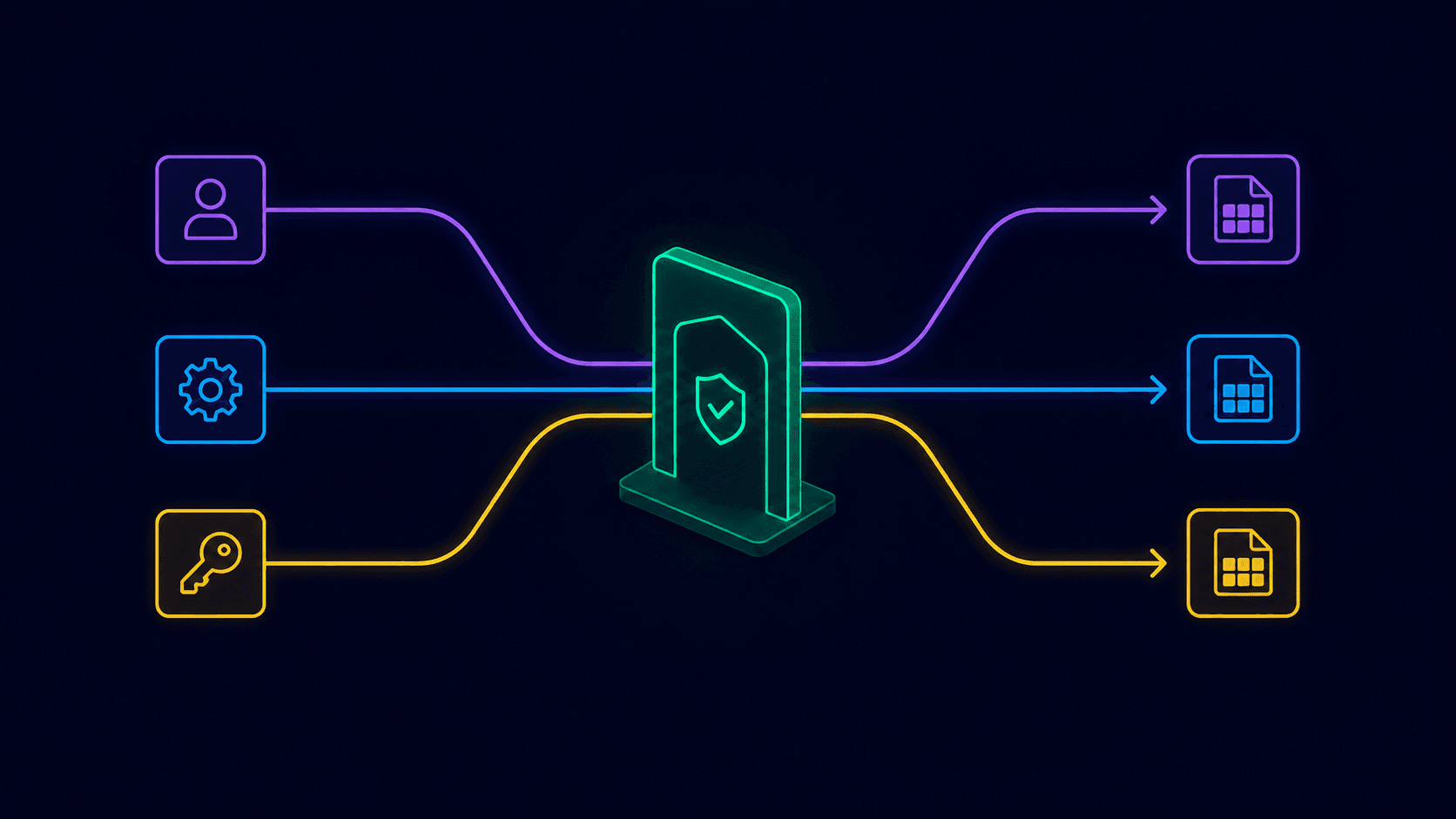 Figure 1: Three tenants' requests converging through one mandatory tenant-scoping layer before diverging back out to each tenant's own isolated result set.
6. Conclusion and Actionable Roadmap
The right MongoDB schema for a B2B SaaS startup isn't determined by embedding-versus-referencing alone - it's determined first by which of the three tenancy models matches your actual customer count and compliance requirements, and second by whether your high-volume subcollections are bucketed instead of left to grow unbounded toward the 16MB document ceiling. Get the tenancy model right and a cross-tenant data leak becomes something the schema itself prevents, not something that depends on every developer remembering a filter; get the Bucket Pattern applied to time-series-shaped data and a document that could have failed writes at 500,000 events instead stays under 50KB indefinitely.
Design your multi-tenant schema before your first enterprise customer, not after an incident: I architect MongoDB and Mongoose data layers for B2B SaaS MVPs with tenant isolation enforced at the schema and query layer from day one. Contact me today to book a 30-minute schema design audit.