How Long Does It Take to Build a SaaS MVP in 2026?


Written by
Bhalli B
Full-Stack Engineer & SaaS MVP Architect
Certified Full-Stack Developer & MVP Specialist · Lahore, Pakistan
A tightly scoped SaaS MVP takes 2 to 4 weeks to build with an experienced independent developer in 2026, and every week beyond that is almost always explained by scope, not skill - a second "hard" feature, a founder who can't review and approve quickly, or a deadline set before anyone actually scoped the work. If you've got a demo day or an investor call on the calendar, this post gives you the real range for your specific build and the three things most likely to blow your date.
1. What's a Realistic MVP Timeline by Complexity?
The honest answer depends entirely on what "MVP" means for your specific product, not on a generic industry number - a simple CRUD tool and an AI-powered product with real-time features are not the same build, even if both get called "an MVP."
| Complexity Tier | What It Looks Like | Realistic Timeline |
|---|---|---|
| Simple CRUD tool | Single user role, forms, a list view, no payments | 1–2 weeks |
| Standard SaaS MVP | Auth, one core workflow, Stripe checkout | 2–4 weeks |
| MVP with one AI feature | Everything above plus an LLM API integration and prompt/output handling | 3–5 weeks |
| Multi-role marketplace/platform | Two+ user roles, real-time features, complex permissions | 6–10+ weeks |
If you have a fixed demo date, work backward from this table before you scope features, not after - How Much Does It Cost to Build a SaaS MVP in 2026? covers how the same complexity jump that adds weeks to your timeline also multiplies your budget.
2. What Actually Determines Your Timeline (Beyond Feature Count)
In practice, this means two projects with the exact same feature list can finish two weeks apart, because timeline isn't only a function of what's being built - it's a function of how fast decisions get made once building starts.
- Founder response time. A developer waiting 3 days for feedback on a design mockup loses those 3 days from the calendar, even though zero hours of actual work were lost.
- Third-party integration reliability. Stripe and most auth providers are fast and predictable in 2026. Less mature or niche APIs can add unplanned days for documentation gaps or sandbox quirks alone.
- AI-assisted development speed. Modern AI coding assistants have genuinely compressed boilerplate and scaffolding time compared to a few years ago - but they speed up typing, not decision-making, so a vague brief still costs you the same clarification days it always did.
- Mid-build scope changes. Every feature added after week one doesn't just add its own time - it usually requires revisiting decisions already made, which is why a change in week three often costs more calendar time than the same feature scoped from day one.
3. The Deadline-Killer: "Just One More Thing"
A founder with a demo in 3 weeks asks, in week 2, to also add a team-invite feature "since it's small." It touches the permissions model already built, and the demo date slips by 6 days fixing what the new feature broke.
"Small" is a feeling, not a scope estimate - any change to a shared system (auth, permissions, data model) tends to cost more than it looks like from the outside.
The same founder writes the team-invite idea down as a v1.1 item the moment it comes up, keeps the original 3-week scope untouched, and hits the demo date with a working, unbroken product.
Anything added after a deadline is locked gets a written "yes, after the demo" instead of a silent scope change - this is the single highest-leverage rule for hitting a hard date.
4. How to Calculate Your Own Realistic Timeline
T = B + (F × D) + R
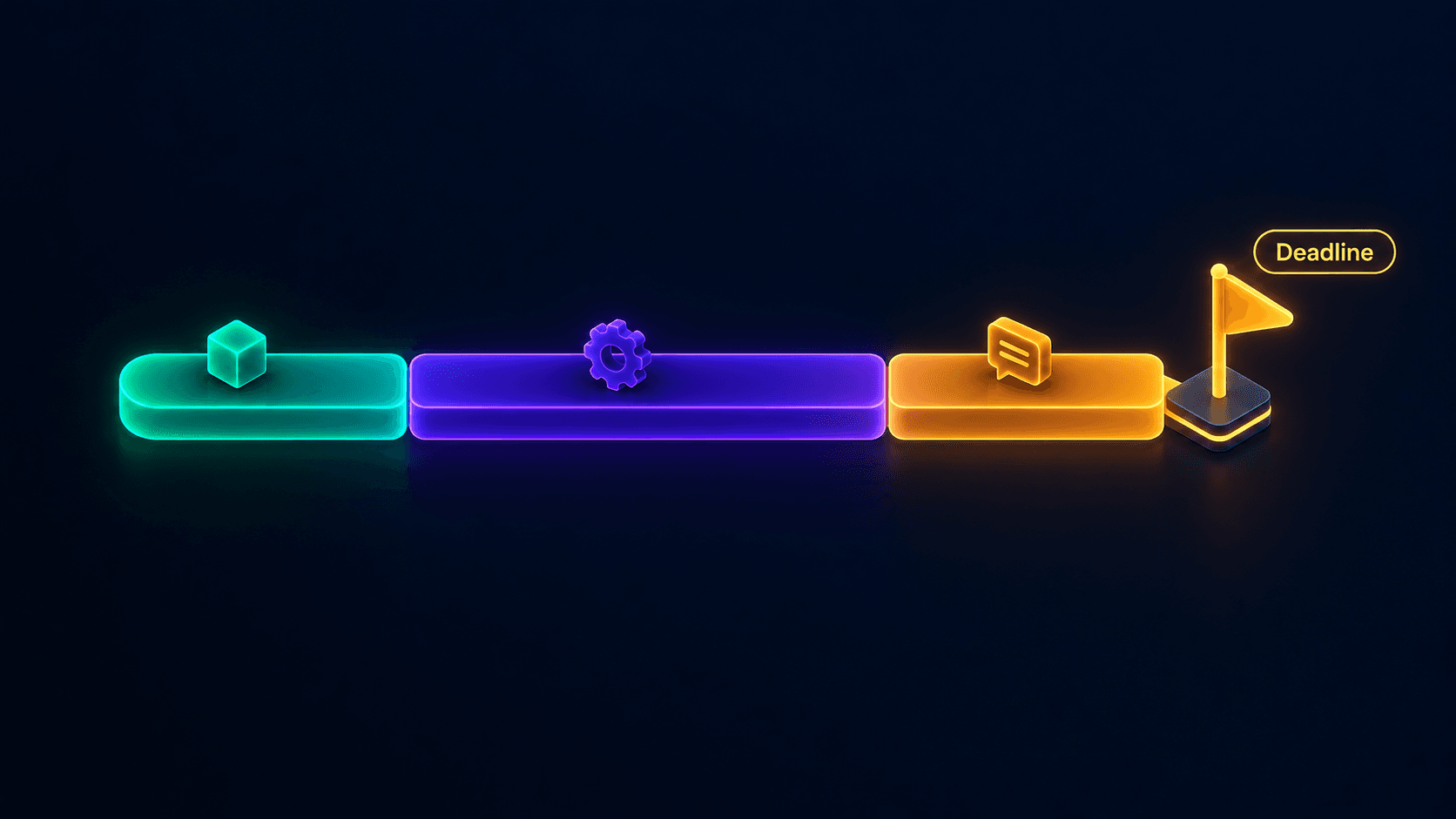 Figure 1: A single horizontal timeline showing how base build time, feature complexity, and founder review lag stack up against a fixed deadline - and where the gap opens when scope isn't locked in advance.
5. How to Protect a Hard Deadline
As a Certified Project Manager, the rule I hold every fixed-deadline project to is simple: the scope gets locked before the calendar does, never the other way around. Concretely, that means:
- Set the deadline after scoping, not before. If the date is already fixed (a funding round, a demo day), scope down to fit it - don't scope up and hope.
- Commit to a same-day feedback window. Even a 24-hour review turnaround instead of 3 days can recover most of the
Rvariable in the formula above. - Write every new idea into a v1.1 list, in the moment it comes up. Not "maybe later" in your head - written down, so it stops feeling urgent right now.
- Ask for a buffer week before you commit the date publicly. A developer's estimate is the time to build; investor demos have zero tolerance for the unexpected day that always shows up somewhere.
6. Conclusion and Actionable Roadmap
Most missed MVP deadlines aren't a development speed problem - they're a scope-lock problem, and the fix costs nothing but discipline: know your complexity tier, lock scope before the date, and commit to fast feedback turnarounds. A tightly scoped MVP genuinely ships in 2 to 4 weeks in 2026, and that number holds as long as nothing gets added to it mid-build.
Working against a real deadline: I build fixed-scope SaaS MVPs as an independent developer, with the scope locked and the timeline committed in writing before work starts - no surprise slips on your demo date. Contact me today to book a 30-minute timeline reality check for your launch date.