How Much Does It Cost to Build a SaaS MVP in 2026?

A SaaS MVP built by a solo developer or small studio in 2026 typically costs between $1,500 and $15,000, not the $50,000+ quotes that scare most first-time founders away before they've even validated their idea. What you pay depends almost entirely on three decisions - who builds it, how much "real" backend you actually need on day one, and whether you're paying for software or paying for someone else's overhead - and by the end of this post you'll know exactly which bucket your idea falls into, plus the specific line items that blow first-time budgets past their limit.
1. What Does "MVP" Actually Mean for Pricing?
Every dollar figure in this post assumes the same definition: an MVP is the smallest version of your product that lets a real paying user complete the core workflow end-to-end - not a prototype, not a clickable Figma file, and not a "full platform, but smaller."
The moment you add scope that doesn't serve that one core workflow - a second user role, an admin dashboard nobody asked for, a settings page with 12 toggles - you're no longer pricing an MVP. You're pricing a v1.0 product, and the number changes accordingly.
As a Certified Project Manager, I scope every MVP against one question before a single line of code gets written: "What is the one action a user has to take, start to finish, for this product to prove itself?" Everything that doesn't serve that action gets pushed to a post-launch backlog. This single filter is what keeps a $1,999 build a $1,999 build instead of quietly becoming a $12,000 one.
2. The Four Ways to Build a SaaS MVP - and What Each One Actually Costs
| Route | Typical Cost | Timeline | Where It Breaks |
|---|---|---|---|
| No-code (Bubble, Webflow + Xano) | $0–$3,000 + $50–$150/mo | 1–3 weeks | Custom auth, AI integrations, real-time features |
| Marketplace freelancer | $1,500–$8,000 | 3–6 weeks | Scope creep, no PM layer, handoff quality varies |
| Independent full-stack architect (e.g. a fixed-scope build like mine) | $1,999–$5,999 | 2–4 weeks | Capacity - one builder, one project at a time |
| Dev agency (2–20 person team) | $15,000–$60,000+ | 6–12 weeks | You're paying for account management and bench overhead, not just code |
No-code gets you the cheapest floor, but it has a hard ceiling: the moment your MVP needs a real AI feature, a custom permission model, or anything beyond CRUD, you hit the platform's walls and end up rebuilding on a real stack anyway - which means you paid twice. Agencies solve capacity and process, but a big chunk of that $15K–$60K quote is covering the agency's account managers, sales team, and idle bench time between projects, not your product.
3. Where the Real Cost Comes From: Feature Complexity, Not Lines of Code
C = B + (F × D) + I
The "base" of any MVP - user auth, a database, basic CRUD screens - is close to a commodity in 2026; frameworks like Next.js 16 and tools like Supabase or Clerk make that part fast for anyone competent. What actually drives your quote up is F × D: every feature that requires real logic (billing, AI, real-time sync, multi-tenant permissions) multiplies cost, because it multiplies edge cases, not just screens.
I ran this exact math with a founder building an AI research assistant: he wanted subscription billing, a live chat widget, and an AI summarization feature all in the MVP. We cut it to just the AI feature and a simple paywall - no chat, no team accounts - and the build came in at $2,499 instead of the $9,000+ it would have hit with everything included. He validated the idea in three weeks and added billing tiers after he had his first ten paying users, not before.
4. The Hidden Costs Nobody Puts in the Quote
Founder pays $3,000 for the build, launches, then gets hit with a $380 OpenAI bill in month one because nobody set token limits or a usage cap on the AI feature - and a $99/mo hosting bill they assumed was "included."
The build cost and the run cost are two different budgets. Treating them as one is the single most common reason early-stage founders panic in month two.
Founder budgets $2,000 for the build, plus a known $60–$120/mo for hosting (Vercel/Railway), database (Supabase/Mongo Atlas), and a hard rate-limited AI usage cap set before launch.
No surprise invoices. The AI feature can only ever cost what you decided it could cost, because the ceiling is enforced in code, not hoped for.
The recurring costs founders consistently underbudget for in 2026:
- Hosting and database: $20–$100/month for a real MVP (Vercel/Railway + Supabase or MongoDB Atlas), not the $0 free-tier number they saw in a tutorial.
- AI API usage: OpenAI and Gemini calls are billed per token - an unthrottled AI feature can go from $10/month to $400/month the moment one user starts hammering it, unless you cap it.
- Payment processing: Stripe takes 2.9% + $0.30 per transaction before you see a cent - fine to plan for, easy to forget when you're modeling revenue.
- Domain, email, and transactional email: $15–$40/month combined (domain registrar, Resend/Postmark, a support inbox).
- Post-launch maintenance: bug fixes and small iterations after week one - either your own time, or a retainer, but never $0.
5. No-Code, Freelancer, or Independent Dev - How to Actually Choose
In practice, this means matching the build route to what you're trying to prove, not to what's cheapest on paper:
- Choose no-code if your MVP is genuinely CRUD - a directory, a booking form, a simple internal tool - with no AI, no custom logic, and you're comfortable hitting a wall if it takes off.
- Choose a marketplace freelancer if budget is your only constraint and you have the time to manage scope yourself, review code, and absorb some quality variance.
- Choose an independent full-stack architect if you want a fixed price, a fixed scope, and a single accountable person who scopes, builds, and ships without a management layer in between - this is the gap a lot of SaaS founders don't know exists between "cheap freelancer" and "expensive agency."
- Choose an agency if you need a bigger team working in parallel, ongoing support SLAs, or you're past MVP and scaling multiple workstreams at once.
6. How to Keep Your First MVP Under $2,000–$3,000
- Cut to one user role. No "admin vs. user" split unless the product literally cannot function without it.
- Use managed services, not custom infrastructure. Auth (Clerk/Supabase Auth), payments (Stripe Checkout, not a custom billing engine), and hosting (Vercel) are commodity in 2026 - building them from scratch is pure budget waste at MVP stage.
- Pick one "hard" feature, not three. If your idea has an AI component, a real-time component, and a marketplace component, that's three MVPs, not one.
- Set usage caps before launch, not after the first scary invoice. Rate-limit AI calls and cap free-tier usage in code from day one.
- Push "nice to have" to a written v1.1 list. Every deferred feature should be written down somewhere the founder can see it - not lost, just not blocking launch.
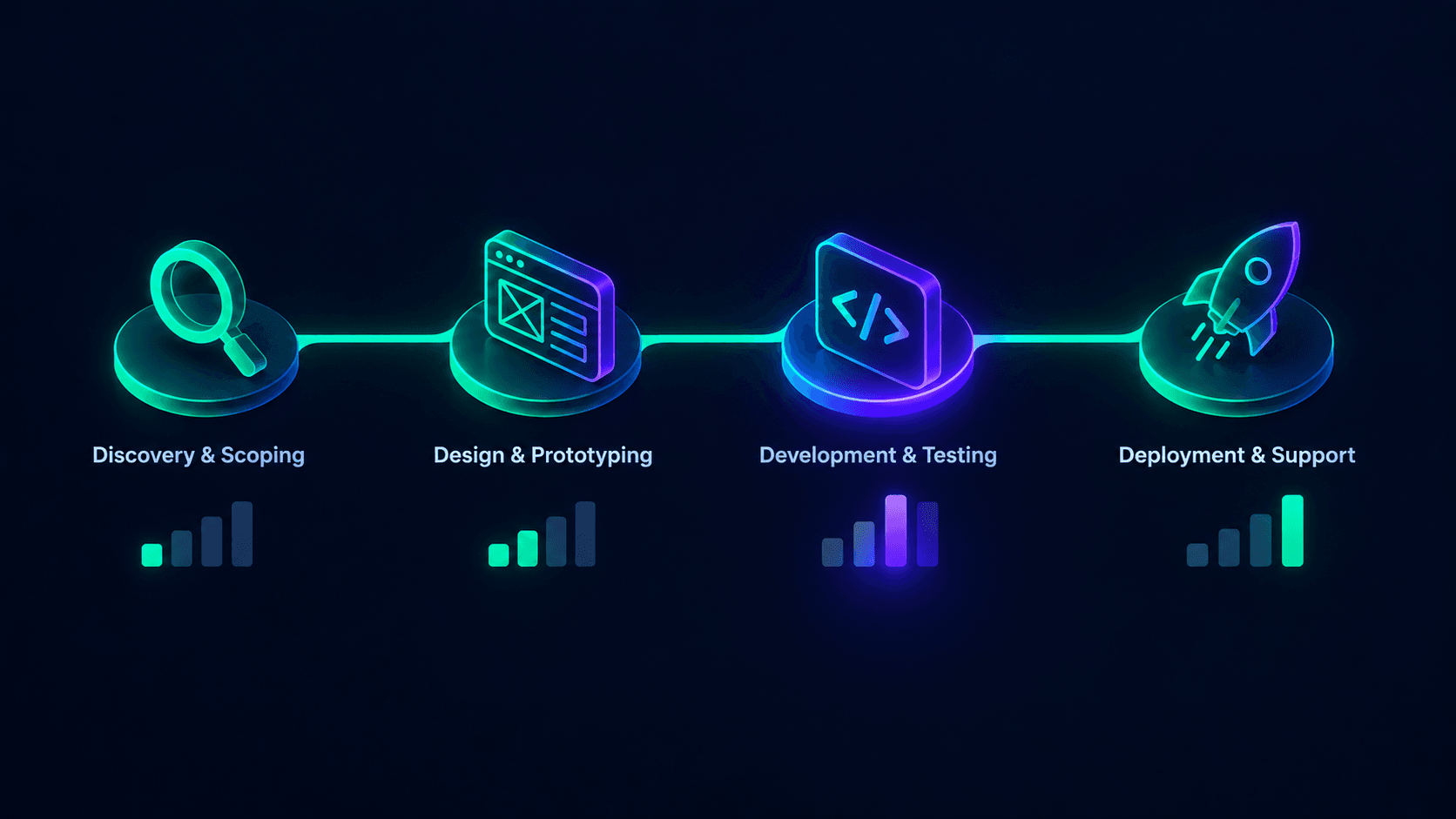 Figure 1: The four phases of a scoped MVP build - Discovery & Scoping, Design & Prototyping, Development & Testing, and Deployment & Support - and where cost typically accumulates when scope isn't locked before phase three.
7. Conclusion and Actionable Roadmap
The real cost of a SaaS MVP in 2026 isn't set by the technology - auth, payments, and hosting are commodities now - it's set by how disciplined the scope stays between "the idea" and "the thing that ships." A tightly scoped MVP with one core workflow and one hard feature lands in the $1,500–$5,000 range with a real developer; the moment you add a second or third "hard" feature before you've validated the first, you're pricing a product, not an MVP, and the number climbs into agency territory fast.
Budget for two numbers, not one: what it costs to build, and what it costs to run for the first three months. Get both in writing before you start, and the $50,000 quote that scared you off in the first place stops being the only option on the table.
Get a fixed-scope MVP quote, not a guess: I build SaaS MVPs end-to-end on Next.js, Node/NestJS, PostgreSQL or MongoDB, and Stripe - fixed price, fixed scope, no surprise invoices - starting at $1,999. Explore MVP pricing plans and pick your build.