Freelancer vs Agency vs In-House: Which Should You Hire?

Picking wrong here doesn't just cost you money - it costs you months, because the failure mode isn't "bad code," it's "the wrong structure for what you actually needed," and you don't find that out until you're three weeks into a project with the wrong person or team attached to it. A freelancer, an agency, and an in-house hire solve three genuinely different problems, not three price points on the same problem, and by the end of this post you'll know which one matches where your product actually is right now.
1. Freelancer, Agency, or In-House - What's Actually Different?
The real difference between these three isn't skill level or even cost - it's what you're buying alongside the code. A freelancer sells you focused execution capacity. An agency sells you a managed process with built-in redundancy. An in-house hire sells you long-term ownership and context that compounds over time.
In practice, this means the question isn't "who's the best developer I can afford" - it's "what am I actually short on right now: hands, process, or continuity?" Founders who skip this question end up hiring an agency to build a two-week MVP (paying for process they don't need yet) or hiring in-house before they have a validated product (paying for continuity they can't use yet).
2. What Does Each Option Actually Cost in 2026?
As a Certified Project Manager who's run projects on all three sides - as a solo freelancer, inside an agency structure, and coordinating in-house teams - the cost comparison people run is almost always incomplete, because they compare the hourly rate and stop there. Here's the fuller picture:
- Freelancer: $20–$100+/hr depending on experience and region, or a fixed-scope project price (a well-scoped MVP commonly runs $1,500–$6,000 with an experienced independent builder). No payroll tax, no benefits, no idle time between tasks - you pay for output, not presence.
- Agency: typically $50–$150+/hr blended rate, with most studios enforcing a project minimum - in the $5,000–$10,000 range is common for a small 2–9 person studio, climbing well past $30,000 for larger agencies with account management layers. You're paying for a team, a PM, and continuity if someone gets sick or leaves.
- In-house: a mid-to-senior full-stack developer typically costs $70,000–$140,000+ in salary depending on region and seniority, and payroll taxes, benefits, equipment, and hiring overhead commonly add another 20–30% on top of base salary - before they've shipped a single feature.
3. Freelancer vs Agency vs In-House: Side-by-Side
| Factor | Freelancer | Agency | In-House |
|---|---|---|---|
| Speed to start | Days | 1–2 weeks | 4–12 weeks to hire |
| Upfront cost | Lowest | Medium–High | Highest (fixed, ongoing) |
| Redundancy if someone's out | None | Built-in | Depends on team size |
| Product context retained | Medium (person-dependent) | Medium (process-dependent) | Highest, compounds over time |
| Best fit stage | Idea validation, MVP #1 | Parallel workstreams, scaling | Post-PMF, long-term roadmap |
4. When Is a Freelancer the Right Call?
A freelancer is the right call when you need to answer one question fast and cheap: "does this product idea actually work?" Independent builders move fastest because there's no account management layer between the person coding and the person deciding - a scope change is a direct conversation, not a ticket routed through a project coordinator.
The trade-off: if that one person gets sick, gets pulled onto another client, or simply isn't the right fit mid-project, you have no built-in backup. That's an acceptable risk for a $2,000 MVP you're testing with 20 users. It's a much bigger risk for a product already generating revenue.
5. When Does an Agency Actually Make Sense?
An agency earns its higher price when you need more than one skill set working in parallel - a backend engineer, a frontend developer, and a designer moving at the same time, coordinated by someone whose job is exactly that coordination. That parallel capacity is what a single freelancer structurally cannot offer, no matter how good they are.
A founder picks the cheapest $25/hr freelancer off a marketplace for a payments-heavy MVP with no vetting beyond price, then spends six weeks and $1,800 in rework fixing a Stripe integration that leaked test keys into a public repo.
The lowest hourly rate is only cheap if the work doesn't need redoing - factor in review time, security review, and rework risk before comparing rates directly.
A founder pays a slightly higher fixed price to a vetted independent builder with a portfolio of shipped fintech work, gets a working Stripe Connect integration on the first pass, and launches two weeks earlier with zero rework cost.
Total cost of ownership - build cost plus rework risk plus time-to-launch - is almost always lower with the right specialist than the cheapest generalist.
6. When Does In-House Actually Win?
In-house wins the moment your roadmap stops being a single project and becomes a permanent, ongoing function - you have product-market fit, a growing codebase, and enough continuous work that the context an in-house hire builds up over months starts compounding into real velocity. Below that threshold, you're paying full-time overhead for part-time-sized problems.
E = (S + O) / H
7. A Simple Framework for Deciding
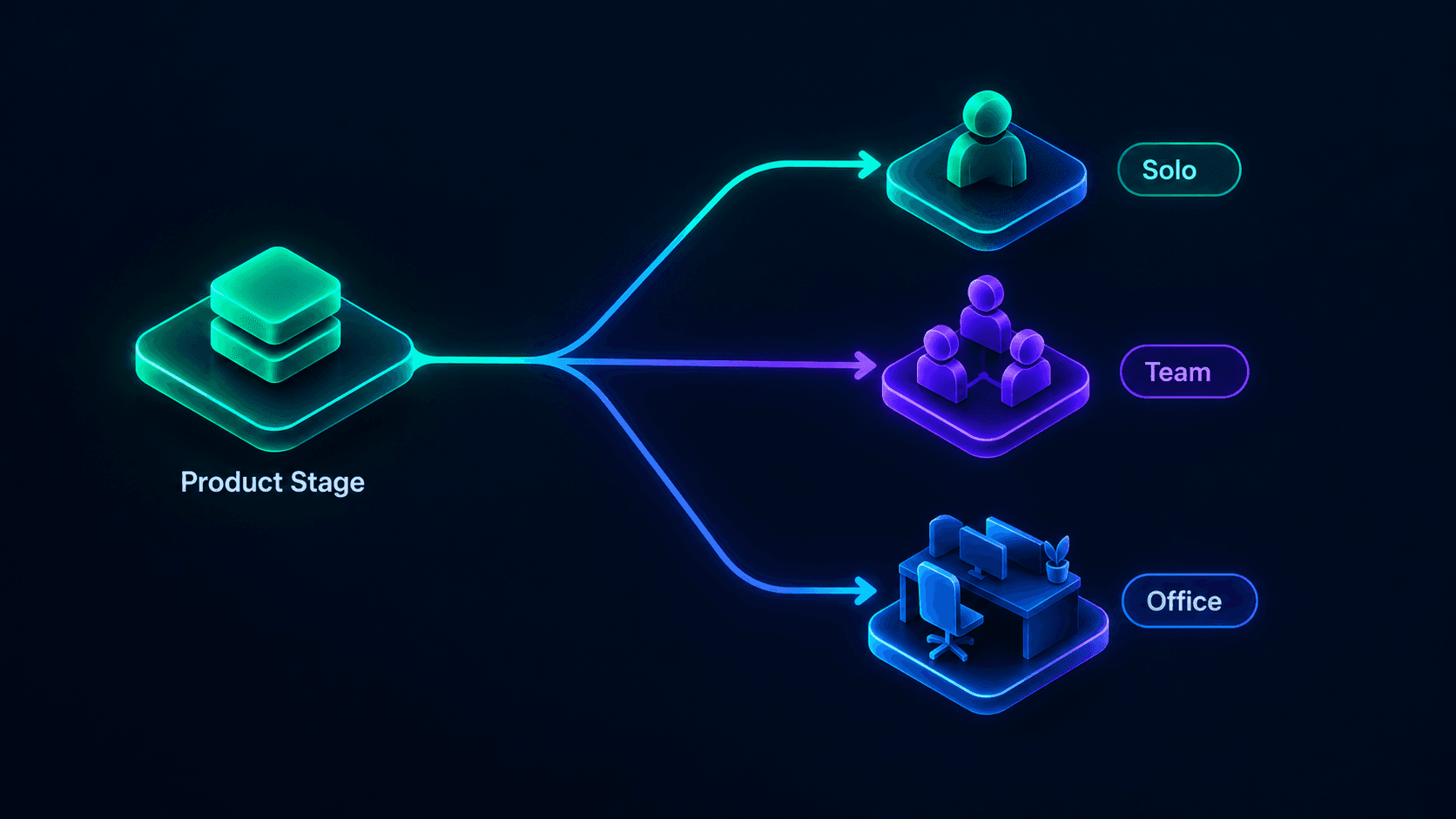 Figure 1: A single decision path from product stage to hiring structure - pre-validation routes to a freelancer, parallel-workstream scaling routes to an agency, and post-PMF ongoing roadmap routes to an in-house hire.
A framework I use with founders trying to decide: match the hire to the stage, not the stage to the hire. Pre-validation and single-feature MVPs point to a freelancer. Multiple parallel workstreams - design, backend, and a mobile app all moving at once - point to an agency. A stable, growing product with a permanent roadmap points to in-house. Fractional or contract-to-hire arrangements exist specifically to bridge the gap between these stages without forcing a premature full-time commitment.
8. Conclusion and Actionable Roadmap
There's no universally "best" option between a freelancer, an agency, and an in-house hire - there's only the option that matches your current stage, and picking the wrong one costs you months of rework or idle overhead, not just a bad hourly rate. Validate with a freelancer, scale parallel work with an agency, and commit to in-house once the roadmap is permanent enough to justify the overhead.
Not sure which stage you're actually at: I work as an independent full-stack architect, taking on fixed-scope MVP and SaaS builds directly - no account managers, no bench overhead, just the person coding as the person you talk to. Contact me today to book a 30-minute hiring-structure audit.