Fintech AI Agents: Why Orchestration Beats the Model


Written by
Bhalli B
Full-Stack Engineer & SaaS MVP Architect
Certified Full-Stack Developer & MVP Specialist · Lahore, Pakistan
A fintech AI agent that can move real money doesn't fail in production because you picked the wrong model - it fails because nothing between the model's decision and the payment API enforces idempotency, nothing logs why the agent chose that specific tool call, and nothing stops it from executing a transaction twice on a retried request. Swapping GPT-5 for Claude or Gemini changes reasoning quality by a few percentage points; a missing idempotency key on a duplicated webhook retry can double-charge a customer, and that's an orchestration failure, not a model failure. This post is the orchestration and observability architecture that determines whether a fintech agent survives contact with production traffic.
1. Why Does Orchestration Matter More Than the Model for a Production Fintech Agent?
The direct answer: model quality determines how well-reasoned an agent's decision is, while orchestration determines whether that decision executes safely, exactly once, and with a reconstructable audit trail - and in a fintech context, the second property is the one regulators, payment processors, and your own postmortems actually care about.
I've reviewed agent prototypes where the entire "architecture" was a single LLM call in a loop with function-calling enabled directly against a live Stripe API key. That setup works flawlessly in a demo because demos don't retry failed requests, don't get duplicate webhook deliveries, and don't have a user closing a browser tab mid-transaction and refreshing. Production traffic does all three, constantly, and none of them are model problems - they're the exact class of problem orchestration layers exist to solve.
2. How Do You Architect an Orchestration Layer Fintech Compliance Actually Requires?
The orchestration layer's job is to sit between the agent's tool-call decision and the actual payment rail, enforcing three things the model itself has no mechanism to guarantee: idempotency (a retried request never executes twice), a deterministic audit trail (every state transition is logged before it happens, not reconstructed after), and a hard boundary on which actions the agent can take without human approval.
// lib/agent-tool-gateway.ts
// Every agent tool call for a money-moving action routes through
// this gateway instead of hitting Stripe directly - idempotency
// and audit logging happen here, once, instead of being
// re-implemented (and re-forgotten) inside every tool definition.
import { randomUUID, createHash } from "crypto";
import Stripe from "stripe";

const stripe = new Stripe(process.env.STRIPE_SECRET_KEY!);

interface AgentTransactionRequest {
  agentSessionId: string;
  toolCallId: string; // unique per LLM tool-call invocation, not per retry
  amount: number;
  currency: string;
  customerId: string;
}

export async function executeAgentPayment(req: AgentTransactionRequest) {
  // Derive a deterministic idempotency key from the tool call ID,
  // NOT a fresh UUID per invocation - if the agent's HTTP request
  // to this gateway gets retried (timeout, network blip), Stripe
  // sees the same key and returns the original charge instead of
  // creating a second one.
  const idempotencyKey = createHash("sha256")
    .update(`${req.agentSessionId}:${req.toolCallId}`)
    .digest("hex");

  // Write the audit record BEFORE calling Stripe, not after -
  // if the process crashes mid-call, you still have a record that
  // this transaction was attempted, which matters far more for a
  // compliance review than a record of only successful charges.
  await auditLog.create({
    id: randomUUID(),
    idempotencyKey,
    agentSessionId: req.agentSessionId,
    toolCallId: req.toolCallId,
    amount: req.amount,
    status: "attempted",
    timestamp: new Date(),
  });

  try {
    const charge = await stripe.paymentIntents.create(
      {
        amount: req.amount,
        currency: req.currency,
        customer: req.customerId,
      },
      { idempotencyKey }
    );

    await auditLog.update(idempotencyKey, { status: "succeeded", stripeId: charge.id });
    return charge;
  } catch (err) {
    await auditLog.update(idempotencyKey, { status: "failed", error: String(err) });
    throw err;
  }
}
As a Certified Project Manager, I scope every fintech agent project with a hard-coded action boundary before any orchestration code gets written - a written list of which transaction types the agent can execute autonomously (refunds under a fixed threshold, subscription renewals) and which always route to a human approval queue (any new-payee transfer, any amount above the threshold). That boundary belongs in the requirements doc, not buried in a prompt instruction the model can be talked out of.
3. What Does Observability Need to Capture When an Agent Touches Real Money?
What a chat-log transcript misses that a fintech postmortem needs: which specific tool the agent called, what arguments it passed, how long each step took, what it cost in model tokens, and - critically - what the agent's reasoning was for choosing that action over the alternatives it considered, all captured as structured, queryable spans rather than a wall of unstructured text.
// lib/agent-tracer.ts
// Wraps every tool call in a structured span so a postmortem can
// answer "why did the agent do this" without replaying the raw
// conversation transcript - spans are queryable by session, tool
// name, or cost, which a text log isn't.
interface AgentSpan {
  spanId: string;
  sessionId: string;
  toolName: string;
  input: Record<string, unknown>;
  output?: Record<string, unknown>;
  reasoningSummary: string; // the agent's stated justification for this call
  startedAt: number;
  durationMs?: number;
  tokenCost?: number;
  status: "started" | "completed" | "failed";
}

export function traceToolCall<T>(
  sessionId: string,
  toolName: string,
  input: Record<string, unknown>,
  reasoningSummary: string,
  fn: () => Promise<T>
): Promise<T> {
  const span: AgentSpan = {
    spanId: crypto.randomUUID(),
    sessionId,
    toolName,
    input,
    reasoningSummary,
    startedAt: Date.now(),
    status: "started",
  };

  return fn()
    .then((result) => {
      // Emit to your tracing sink (OpenTelemetry, or a plain
      // structured-log table) on both success and failure paths -
      // a failed tool call is often the more important record.
      emitSpan({ ...span, output: result as any, status: "completed", durationMs: Date.now() - span.startedAt });
      return result;
    })
    .catch((err) => {
      emitSpan({ ...span, status: "failed", durationMs: Date.now() - span.startedAt });
      throw err;
    });
}
A gotcha I hit building this: the first version only logged tool inputs and outputs, not the reasoningSummary field - and the first time a client asked "why did the agent decline this refund," the trace showed exactly what was called and what it returned, but not why the agent chose to decline instead of approve. Adding a required one-line reasoning field to every tool call closed that gap, and it's now the field compliance reviewers ask for first.
4. How Do You Stop an Agent From Executing an Unintended Transaction?
// The model gets direct function-calling access to Stripe with
// no intermediate gate - any amount, any recipient, no approval.
const tools = [{ name: "create_payment", handler: stripe.paymentIntents.create }];
await runAgentLoop(userMessage, tools);
A single prompt-injection attempt embedded in a customer message, or a model hallucinating an amount, executes directly against Stripe with no checkpoint - nothing in this path can stop it.
// Amounts above the threshold route to a human approval queue
// instead of executing immediately - the agent can still propose
// the action, but can't unilaterally complete it.
const APPROVAL_THRESHOLD_CENTS = 50000; // $500

async function createPaymentTool(args: PaymentArgs) {
  if (args.amount > APPROVAL_THRESHOLD_CENTS) {
    return enqueueForHumanApproval(args);
  }
  return executeAgentPayment(args); // routes through the idempotent gateway
}
The agent's authority is bounded by a threshold a human set explicitly, so the worst a hallucinated or injected instruction can do autonomously is capped, not unlimited.
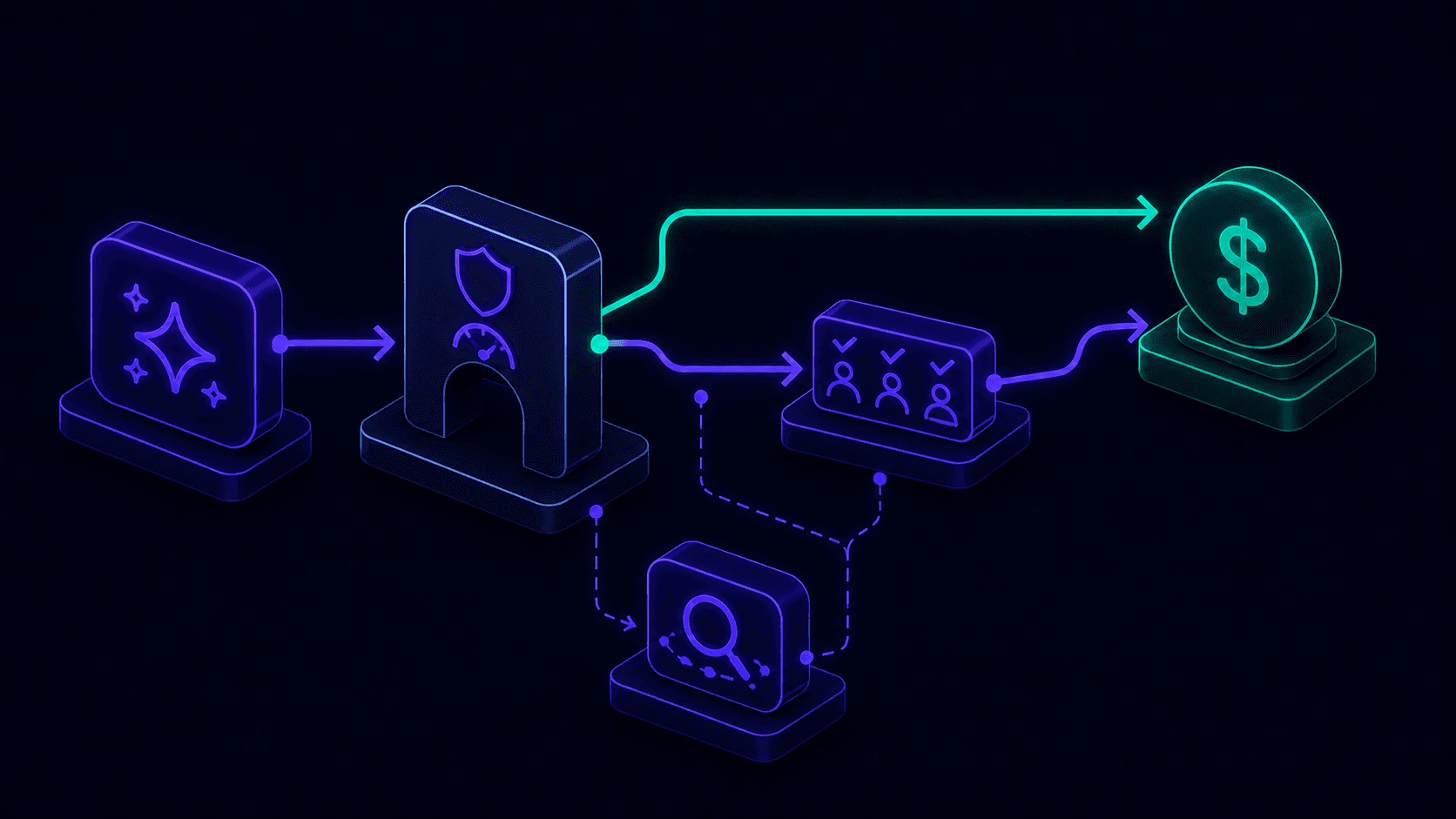 Figure 1: An agent's tool call passes through the idempotent gateway (Section 2) and gets traced as a structured span (Section 3) before either executing directly or routing to human approval, depending on the threshold check.
5. Which Orchestration Pattern Should You Actually Choose?
L = L_agent + (P × L_review)
| Pattern | Auditability | Failure Isolation | Best For |
|---|---|---|---|
| Single-agent loop (raw function calling) | Low - reasoning buried in conversation history | Poor - one bad decision has no containment | Prototypes and demos only |
| Deterministic state machine with LLM-filled steps | High - every transition is a logged, named state | Strong - invalid transitions are structurally rejected | Most production fintech agents |
| Multi-agent graph (planner + specialist agents) | Medium - traceable per-agent, complex to reconstruct end-to-end | Medium - isolated per agent, coordination failures are subtle | Complex workflows spanning multiple financial systems |
If the agent is also the thing customers transact through - not just an internal automation - the same merchant-of-record and Shared Payment Token model I covered in integrating Stripe's Agentic Commerce Suite applies directly, since ACP's checkout lifecycle is itself a deterministic state machine for exactly this reason.
6. Conclusion and Actionable Roadmap
A production-ready fintech AI agent is defined by its orchestration layer, not its model: idempotent execution that survives retries, structured tracing that captures the agent's reasoning alongside its actions, and a hard-coded approval threshold that bounds what it can do autonomously. Get those three right on a deterministic state machine and the model underneath becomes a swappable component - get them wrong and no model, however capable, makes the system safe to put in front of real money. That AI API cost itself needs its own budget line too, alongside the orchestration work - a detail a realistic SaaS MVP budget breaks down further.
Building an AI agent that needs to move real money safely? I architect fintech AI agent systems - idempotent transaction gateways, structured observability, and approval-gated orchestration - on Next.js, Node.js, and Stripe Connect. Contact me today to book a 30-minute agent architecture audit.