AgentCore Payments vs Binance Agent OS for Builders


Written by
Bhalli B
Full-Stack Engineer & SaaS MVP Architect
Certified Full-Stack Developer & MVP Specialist · Lahore, Pakistan
In August 2026, AWS and Binance both shipped infrastructure that lets an autonomous AI agent spend real money without a human clicking "approve" on every transaction - and if you're building fintech products right now, that changes what "integration" means for your roadmap. Amazon Bedrock AgentCore Payments turns Bedrock agents into x402-speaking wallets that settle USDC through Coinbase or move fiat through Stripe's Privy wallet infrastructure, while Binance Agent OS gives that same class of agent direct, subaccount-isolated access to spot trading, on-chain transfers, and its own x402 facilitator. Neither is a pilot: AgentCore Payments is already live in preview across four AWS regions, and Binance's rails are handling authorized trades for agents running inside Claude Code, Cursor, and ChatGPT today. This post breaks down both architectures, shows you the exact spend-cap pattern that stops a mis-behaving agent from draining a wallet, and gives you working TypeScript you can adapt in a sprint.
1. What Do AgentCore Payments and Binance Agent OS Actually Do?
Both products answer the same underlying question - "how does an agent authorize a transaction without holding a human's full credentials?" - but they solve it for different transaction shapes.
AgentCore Payments: Bedrock-Native Micropayment Infrastructure
AgentCore Payments is a managed service inside Amazon Bedrock AgentCore, built for machine-to-machine micropayments: an agent hitting a paid API, an MCP server, or a piece of gated content mid-task. It's governed by the same identity, gateway, and observability stack as every other AgentCore action, which matters more than it sounds - it means a payment call gets the same IAM policy enforcement and CloudWatch trace as a database read. Coinbase's x402 Bazaar MCP server is wired directly into the AgentCore gateway, so an agent can discover payable endpoints the same way it discovers tools.
Binance Agent OS: Trading and On-Chain Access for Agents
Binance Agent OS is a different animal. It's a developer platform that connects external AI applications - ChatGPT, Claude Code, Codex, Cursor - to Binance's trading engine, wallet system, and market data, via the Binance Wallet Agentic Hub, Binance's own x402 transaction verification and payment facilitator API, Binance Skill Hub, and now MCP support. Where AgentCore Payments is built for an agent buying access to a resource, Agent OS is built for an agent executing financial decisions - placing spot trades, checking a balance, moving funds - inside a dedicated, permission-scoped subaccount that isolates it from the user's main wallet.
If you're building a research agent that needs to pay per API call, you want AgentCore Payments. If you're building a trading, treasury, or portfolio-monitoring agent, you want Agent OS. Most serious fintech products in 2026 end up needing both patterns at once.
2. How Does an Agent Payment Actually Settle?
In practice, this means understanding one protocol before anything else: x402, the HTTP-native payment standard both AWS and Binance have adopted as their settlement layer for machine payments.
The x402 Handshake, Step by Step
- The agent calls a paid endpoint (an API, an MCP tool, a data feed).
- The server responds with HTTP
402 Payment Required, including the price and accepted payment rails in the response headers. - AgentCore Payments (or Binance's facilitator) generates a signed payment proof within the boundaries of a pre-approved, budget-capped session - using EIP-3009 for EVM assets or an SPL token transfer for Solana, per AWS's own reference implementation.
- The agent retries the original call with a
PAYMENT-SIGNATUREheader attached. - The server verifies the proof against the x402 facilitator and returns the resource.
The application code never hands the model a live private key or a card number - it hands the model a bounded session, and the session does the signing. That distinction is the entire security model. As a Certified Project Manager, I flag this as the one line item that should never slip from a PRD to a "we'll add it later" backlog ticket: the budget cap is not a nice-to-have, it's the feature.
Who Verifies the Payment Proof?
On AgentCore's side, verification runs through dual authentication - OAuth for the agent's bearer token, validated against AgentCore Identity, and AWS SigV4 for anything calling the payments API directly with IAM credentials. Binance's facilitator instead checks the proof against the subaccount's configured permission set (which assets, which counterparties, which daily ceiling) before it ever reaches the exchange's matching engine. Both approaches converge on the same principle: verification is application-owned, not model-owned. The LLM decides when to pay; it never decides whether it's allowed to.
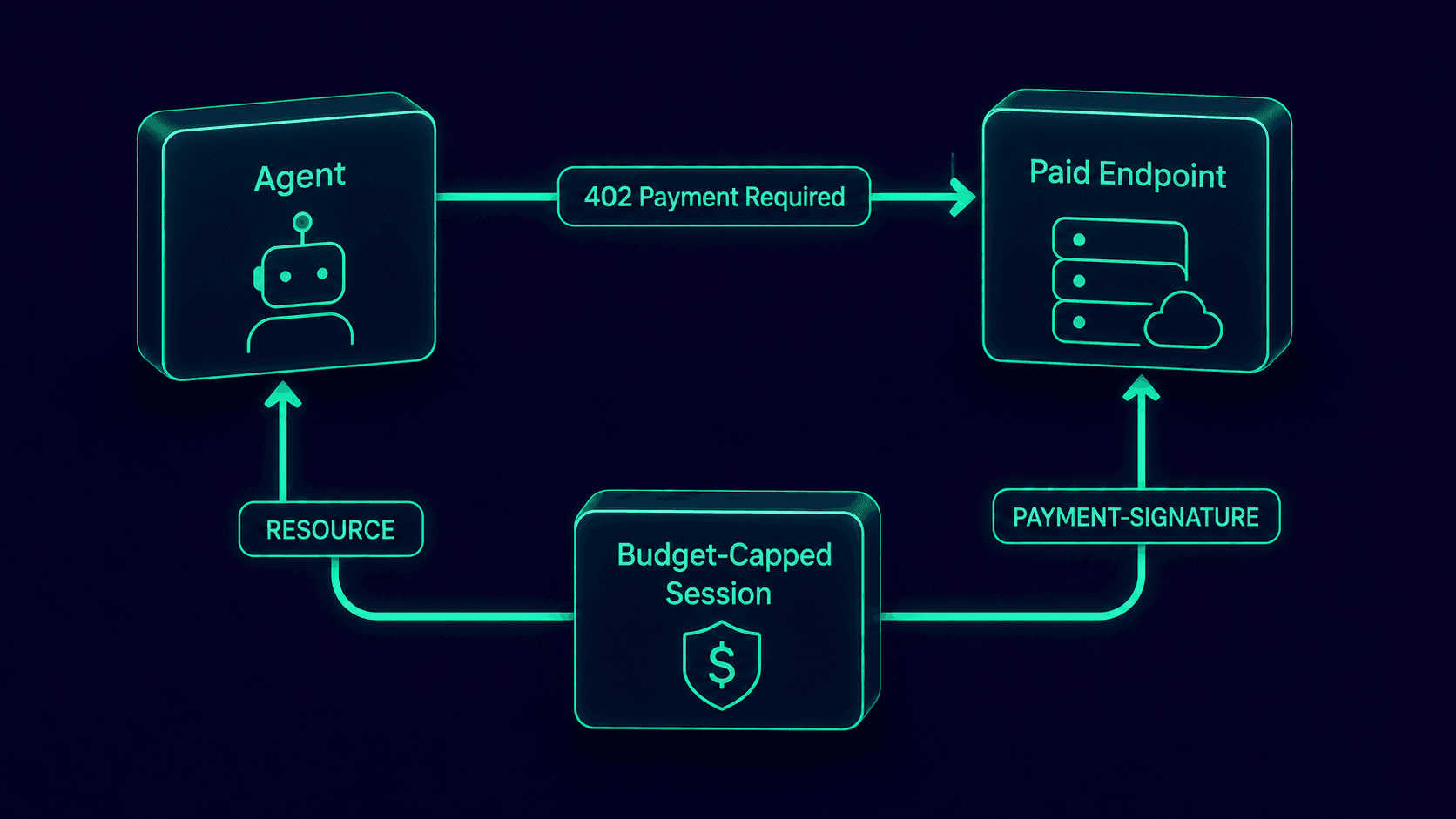 Figure 1: The x402 handshake - the agent's 402 retry loop happens entirely inside a pre-approved, budget-capped session that the application controls, not the model.
3. AgentCore Payments vs Binance Agent OS vs Stripe's Agentic Commerce Protocol
Stripe's own Agentic Commerce Protocol (ACP), co-developed with OpenAI and now extended with Shared Payment Tokens for partners like Affirm, is the third rail most fintech teams end up evaluating alongside these two - I go deeper on wiring it into a checkout flow in Agentic Commerce and Stripe: An Integration Guide. Here's how the three actually compare for a builder deciding where to start:
| Dimension | AgentCore Payments | Binance Agent OS | Stripe ACP |
|---|---|---|---|
| Primary use case | Agent pays for API/MCP/content access | Agent trades and moves crypto assets | Agent completes a consumer checkout |
| Settlement rail | USDC via x402/Coinbase, or fiat via Stripe Privy | Binance-native trading engine + x402 facilitator | Card rails via Shared Payment Tokens |
| Isolation model | Time-bounded payment session, per-task budget | Dedicated subaccount with instant revoke | Scoped token, single merchant/checkout |
| Identity/auth | OAuth + AWS SigV4, AgentCore Identity | Binance account permissions, per-agent scoping | Stripe merchant auth + SPT |
| Maturity (as of Aug 2026) | Preview, 4 AWS regions | Launched Aug 20, 2026 | GA, live with Etsy and Shopify merchants |
Notice none of these are mutually exclusive. A research agent I've architected recently uses AgentCore Payments to pull paid market-data feeds mid-task, and would use Agent OS-style subaccount isolation if it ever needed to act on that data by placing a trade - two different payment surfaces on one agent, deliberately kept in separate trust boundaries.
4. What's the Real Cost Risk of an Unbounded Spending Agent?
What this costs you if you get it wrong: an agent that retries a paid call on every transient failure, with no cap on retries or session spend, doesn't fail loudly - it just quietly compounds a small per-call price into a large daily bill. The formula that actually matters at the architecture-decision stage isn't the sticker price of a single x402 call; it's the effective per-task cost once retries and settlement overhead are counted.
C = (n × p) + (n × f)
This is a back-of-envelope illustration, not a live AWS or Binance price quote - plug in your own metering numbers before you present this to a client. Two scenarios at 10,000 agent tasks/day:
5. How Do You Actually Build a Spend-Capped Payment Agent?
In practice, this means the session budget and the retry cap both need to live in code your team controls - never in the prompt, and never as a suggestion to the model.
System prompt: "You have a budget of $5. Do not exceed it." Wallet holds a long-lived key with no on-chain or session-level cap.
The model is the only thing standing between a hallucinated retry loop and an empty wallet. I've watched a client's staging agent blow through a "prompted" limit in under ten minutes because a retried tool call reset its own context on the budget instruction.
A finite-budget AgentCore payment session (or Binance subaccount limit) is created before the agent runs. Every payment call is checked against the remaining session balance server-side, not by the model.
The worst case is a rejected 402 retry, not a drained wallet - the cap is physically enforced by infrastructure the model can't reason its way around.
Here's the pattern for creating a bounded AgentCore payment session before handing control to the model. I'm using the OpenAI Agents SDK shape here since that's the one AWS ships in its own cookbook, but the session-first principle holds regardless of which agent framework you're on:
// payment-session.ts
// Creates a time-bounded, budget-capped AgentCore payment session
// BEFORE the agent is allowed to make its first tool call.
import { AgentCoreClient } from "@aws-sdk/client-agentcore-payments";

const agentCore = new AgentCoreClient({ region: "us-east-1" });

interface SessionConfig {
  agentId: string;
  maxBudgetUsd: number;   // hard ceiling, enforced server-side
  maxRetries: number;     // per-endpoint retry cap
  ttlSeconds: number;     // session auto-expires, no lingering authority
}

export async function createBoundedSession(config: SessionConfig) {
  // NOT_READY is a valid, expected response in local/dev - the SDK
  // refuses to open a live session unless payment opt-ins and role
  // separation are explicitly configured. Don't swallow this.
  const readiness = await agentCore.checkReadiness({ agentId: config.agentId });
  if (readiness.status !== "READY") {
    throw new Error(`Payment session refused: ${readiness.reason}`);
  }

  const session = await agentCore.createPaymentSession({
    agentId: config.agentId,
    budget: { currency: "USDC", maxAmount: config.maxBudgetUsd },
    retryPolicy: { maxAttemptsPerEndpoint: config.maxRetries },
    ttlSeconds: config.ttlSeconds,
    // Wallet provider is explicit, never inferred - Coinbase CDP
    // for stablecoin rails, Stripe Privy for fiat-backed rails.
    walletProvider: "coinbase-cdp",
  });

  return session; // pass session.id to the agent's tool-calling context
}
Once the session exists, the agent's tool needs to actually enforce the 402 handshake instead of trusting the model to retry sanely. This Express middleware sits in front of every outbound paid call, logs every attempt for audit, and hard-stops on session exhaustion:
// x402-guard.ts
// Middleware that intercepts a 402 response, checks it against the
// session's remaining budget, and only then requests a payment proof.
import type { Request, Response, NextFunction } from "express";
import { agentCore } from "./payment-session";
import { auditLog } from "./audit"; // writes to Postgres via Prisma

export async function x402Guard(req: Request, res: Response, next: NextFunction) {
  const sessionId = req.headers["x-agentcore-session-id"] as string;
  if (!sessionId) {
    return res.status(400).json({ error: "Missing payment session context" });
  }

  try {
    const upstream = await fetch(req.body.targetUrl, { method: "GET" });

    if (upstream.status !== 402) {
      return next(); // no payment required, pass through untouched
    }

    const priceHeader = upstream.headers.get("x-payment-required");
    const price = priceHeader ? parseFloat(priceHeader) : 0;

    // Server-side budget check - this is the actual enforcement point,
    // not the model's instructions.
    const remaining = await agentCore.getSessionBalance(sessionId);
    if (remaining < price) {
      await auditLog.write({ sessionId, event: "BUDGET_EXCEEDED", price });
      return res.status(402).json({ error: "Session budget exhausted" });
    }

    const proof = await agentCore.processPayment({ sessionId, amount: price });
    const paid = await fetch(req.body.targetUrl, {
      headers: { "PAYMENT-SIGNATURE": proof.signature },
    });

    await auditLog.write({ sessionId, event: "PAYMENT_SETTLED", price, proofId: proof.id });
    return res.json(await paid.json());
  } catch (err) {
    // Never fail open on a payment path - an unhandled error here
    // must block the call, not silently retry it.
    await auditLog.write({ sessionId, event: "GUARD_ERROR", error: String(err) });
    return res.status(502).json({ error: "Payment guard failed closed" });
  }
}
That auditLog.write call on every branch - success, budget-exceeded, and error - is the detail teams skip under deadline pressure and regret during their first compliance review. It's also the exact pattern I walked through in more depth on the orchestration side in Orchestrating AI Agents for Fintech Workflows, if you're wiring this into a broader multi-agent pipeline rather than a single payment-capable tool.
6. Conclusion and Actionable Roadmap
AgentCore Payments and Binance Agent OS are the same wager stated two different ways: AWS is betting that machine-to-machine micropayments become the connective tissue between agents and paid resources, and Binance is betting that agents become a primary interface for trading and treasury management. Neither company is asking you to trust the model with the money - both architectures put the enforcement point in application-owned infrastructure: a budget-capped session on AWS, a permission-scoped subaccount on Binance. Build to that principle regardless of which rail you pick, and the actual dollar exposure of a misbehaving agent drops from "unbounded" to "the size of the session you configured" - in the worked example above, a 75% reduction from a single retry cap alone.
Ship agent payments without the 2 a.m. wake-up call: I architect spend-capped, audit-logged payment infrastructure for AI agents on exactly this stack - Next.js, TypeScript, AgentCore Payments, x402, and Binance/Stripe rails where the product calls for it. Contact me today to book a 30-minute agentic payments architecture audit.