Scope a Multi-Tenant SaaS MVP to Ship in 8 Weeks


Written by
Bhalli B
Full-Stack Engineer & SaaS MVP Architect
Certified Full-Stack Developer & MVP Specialist · Lahore, Pakistan
Shipping a multi-tenant SaaS MVP in 8 weeks is a scope-discipline problem before it's a code problem - the timeline breaks almost every time not because the team codes too slowly, but because the tenancy model gets picked without a deadline in mind and the feature list never gets cut hard enough to fit the hours actually available. In practice, this means the founders who hit 8 weeks aren't writing code faster than everyone else; they're cutting the same three things every time, in the same order, before a single sprint starts. This post is the exact framework - tenancy model choice, an hour budget, and a deliberate cut list - that gets a real multi-tenant B2B SaaS MVP to a ship date instead of a slipping estimate.
1. What Does "Ship in 8 Weeks" Actually Require You to Cut?
What this costs you if you get this wrong: most 8-week MVP timelines fail not because the team underestimated a single feature, but because nobody ever converted the full feature wishlist into an hours budget against the calendar - so the slip happens gradually, one "small addition" at a time, until week 6 arrives with week 10's worth of work still open.
In practice, this means the first scoping step isn't picking features - it's picking a number. An 8-week MVP built by one full-time architect gives you roughly 320 working hours (8 weeks × 40 hours), and every feature, every integration, and the tenancy model itself has to fit inside that number or something else has to leave the list. I run this as a hard constraint on client projects specifically because a soft constraint ("we'll try to hit 8 weeks") always loses to scope creep.
2. Which Multi-Tenancy Model Should You Actually Build First?
The tenancy model is the one architectural decision in a multi-tenant MVP that's genuinely expensive to change after launch, because it determines your database schema, your query patterns, and your data-isolation guarantees all at once - get it wrong and you're not refactoring a feature, you're migrating live tenant data.
There are three real options, and for an 8-week MVP the choice usually isn't close:
| Model | Setup Time | Isolation Strength | Best For |
|---|---|---|---|
| Shared schema (tenant_id column) | ~1-2 days | Application-enforced, backed by row-level security | 8-week MVPs - the only model that fits the budget |
| Schema-per-tenant (Postgres schemas) | ~1-2 weeks | Strong - database-enforced separation | Post-MVP, once you have compliance-driven tenants |
| Database-per-tenant | 2-4+ weeks, plus ongoing ops overhead | Strongest - full physical separation | Enterprise deals requiring dedicated infrastructure, not an MVP |
Shared schema wins for an 8-week MVP for one reason: it's the only model where the setup cost is small enough to leave the remaining ~300 hours for actual product features. The same tenant_id-leading compound index discipline I detailed in handling millions of rows in MongoDB applies directly here - whether you're on Postgres or Mongo, tenant_id needs to lead every compound index your tenant-scoped queries touch, or your query planner scans across every tenant's data to find one tenant's rows.
3. How Do You Stop Tenant Data From Leaking Across Accounts?
What this costs you if you get it wrong: a single Prisma query that forgets its where: { tenantId } clause doesn't throw an error - it silently returns another tenant's data, and in a shared-schema model that's the entire security model failing at once, not a minor bug.
// Every route handler has to remember to add tenantId itself -
// one missed filter and you've leaked cross-tenant data.
const invoices = await prisma.invoice.findMany({
  where: { status: "pending" }, // missing tenantId - leaks every tenant's invoices
});
This compiles, runs, and returns real data - it just returns every tenant's pending invoices to whichever tenant happened to make the request, and nothing in the stack trace tells you that happened.
// lib/tenant-prisma.ts
// A Prisma Client Extension that injects tenantId into every
// findMany/findFirst/update/delete call automatically - a
// forgotten filter becomes structurally impossible instead of
// a code-review hope.
import { PrismaClient } from "@prisma/client";

export function getTenantClient(tenantId: string) {
  const base = new PrismaClient();

  return base.$extends({
    query: {
      $allModels: {
        async $allOperations({ args, query, model }) {
          // Skip models without a tenantId column (e.g. global config tables)
          const tenantScopedModels = ["Invoice", "Project", "TeamMember"];
          if (tenantScopedModels.includes(model)) {
            args.where = { ...args.where, tenantId };
          }
          return query(args);
        },
      },
    },
  });
}
Every route handler pulls its Prisma client from the authenticated request's tenant context, so tenant scoping happens once at the client layer instead of being re-implemented (and re-forgotten) in every query.
// middleware/tenant-context.ts
// Extracts tenantId from the verified JWT and attaches a
// tenant-scoped Prisma client to the request - route handlers
// never touch the raw, unscoped PrismaClient at all.
import { NextRequest, NextResponse } from "next/server";
import { jwtVerify } from "jose";
import { getTenantClient } from "@/lib/tenant-prisma";

export async function withTenantContext(
  req: NextRequest,
  handler: (req: NextRequest, db: ReturnType<typeof getTenantClient>) => Promise<NextResponse>
) {
  const token = req.headers.get("authorization")?.replace("Bearer ", "");
  if (!token) {
    return NextResponse.json({ error: "Unauthorized" }, { status: 401 });
  }

  const { payload } = await jwtVerify(token, new TextEncoder().encode(process.env.JWT_SECRET!));
  const tenantId = payload.tenantId as string;

  if (!tenantId) {
    // Defense in depth: a token without a tenantId claim should
    // never reach a handler that assumes one exists.
    return NextResponse.json({ error: "Missing tenant context" }, { status: 403 });
  }

  return handler(req, getTenantClient(tenantId));
}
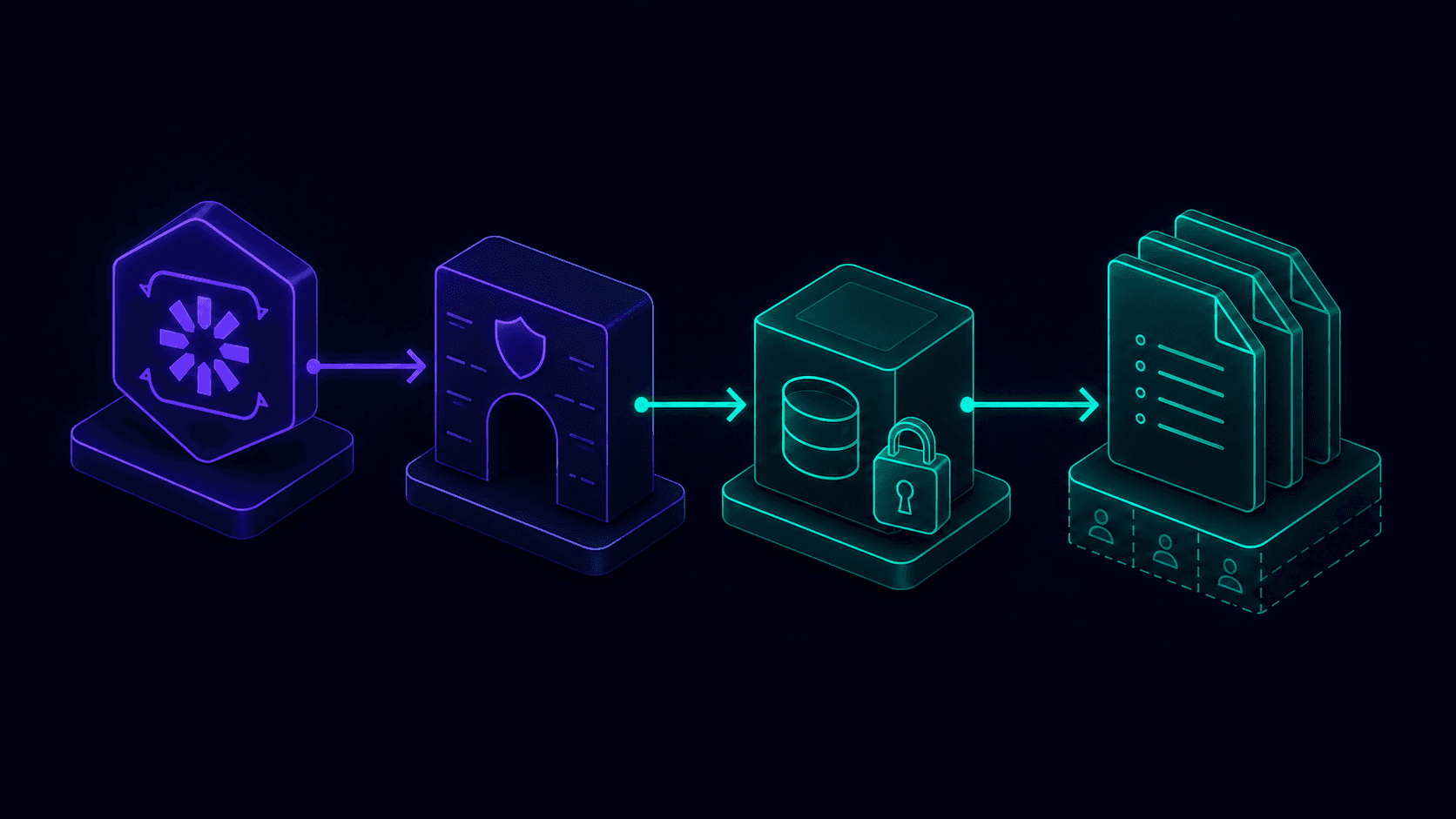 Figure 1: A request's JWT carries the tenant ID through middleware into a tenant-scoped Prisma client, so every query downstream is automatically filtered without relying on each handler remembering to do it.
4. How Do You Fit the Feature List Inside an 8-Week Hour Budget?
B = W × H
As a Certified Full Stack Engineer and a Certified MVP Builder, I split every 8-week MVP into thirds against that 320-hour budget: roughly the first third goes to the tenancy foundation and auth (the shared-schema setup, the scoped Prisma client, the middleware), the middle third to the core tenant-facing features that actually differentiate the product, and the final third held as buffer for integration bugs and the hardening pass - never allocated to new features, no matter how tempting a mid-sprint request feels.
5. What Should You Deliberately Defer Past Week 8?
In practice, this means treating a specific list as "not in this MVP" rather than "somehow squeezed in" - role-based permissions beyond owner/member, usage-based billing tiers, audit logs, and schema-per-tenant migration for enterprise prospects all belong on a documented post-launch roadmap, not inside the 8-week scope.
None of these are unimportant - they're just not what determines whether your first real tenant can sign up, invite a teammate, and use the core feature loop. Deferring them explicitly, in writing, before week 1 starts is what prevents them from quietly re-entering scope in week 5 when a stakeholder asks "can we also add..."
6. Conclusion and Actionable Roadmap
An 8-week multi-tenant SaaS MVP ships when the tenancy model gets picked for the timeline (shared schema, not schema-per-tenant), the feature list gets cut against a real 320-hour budget instead of a wishlist, and tenant scoping gets enforced structurally at the client layer instead of hoped for in code review. Every founder I've seen hit their 8-week date did all three before writing feature code - every slipped timeline I've inherited skipped at least one.
Need your multi-tenant MVP scoped against a real 8-week budget instead of a hopeful estimate? I architect and ship production multi-tenant SaaS MVPs on Next.js, Prisma, and PostgreSQL, with tenant isolation enforced at the client layer from day one. Contact me today to book a 30-minute MVP scoping audit.