Next.js vs. React for Startups: Why I Choose the App Router for MVPs

Written by
Bhalli B
Full-Stack Engineer & SaaS MVP Architect
Certified Full-Stack Developer & MVP Specialist · Lahore, Pakistan
For a startup MVP in 2026, choosing the Next.js App Router over a standard React Single Page Application (SPA) is the most critical technical decision you can make to accelerate time-to-market. Next.js App Router consolidates frontend routing, backend server logic, API generation, and automatic SEO-optimized rendering into a single, unified codebase. This unified architecture slashes your engineering costs by up to 50%, eliminates the security and latency bottlenecks of decoupled APIs, and guarantees your product is fully crawlable by search engines from day one.
The Framework vs. SPA Myth: What Founders Often Get Wrong
When startup founders outline their initial product scope, they often tell me, "We are going to build our web app in React to keep it simple, and we will worry about a framework later."
This statement contains a fundamental architectural misunderstanding. React is not an alternative to Next.js; React is the engine that powers Next.js.
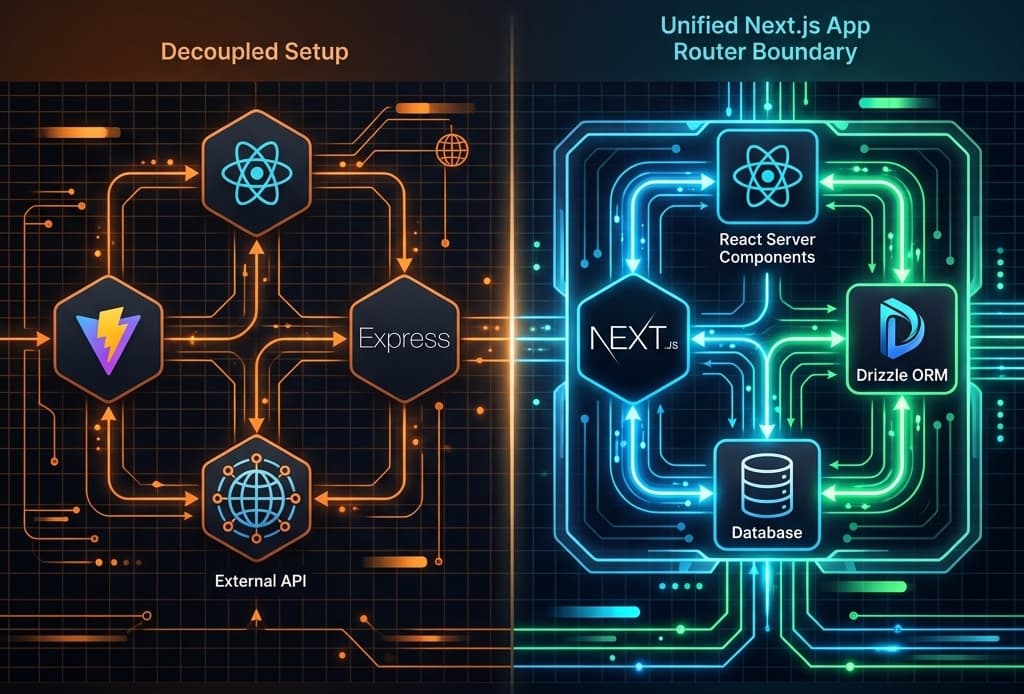
Choosing "just React" means you are choosing to build a Single Page Application (SPA), typically using Vite as a build tool, React Router for client-side navigation, and TanStack Query to pull data from a separate backend. This is the classic decoupled approach.
While highly flexible, starting with a plain React SPA forces your developers to spend the first 40 to 80 hours of your runway manually wiring together routing, authentication, data-fetching wrappers, and build configurations. Next.js, on the other hand, is a full-stack meta-framework. It provides a standardized, battle-tested structure out of the box, allowing your team to skip the plumbing and focus 100% of your limited budget on building the actual features your customers will pay for.
The Page-Split Decision Matrix: SEO vs. Inner-App Workloads
A common pitfall for early-stage software companies is ignoring organic search traffic until after the product is built. If your customer acquisition strategy relies on content marketing, landing pages, or product catalogs, a traditional React SPA is a structural growth killer.
The Technical SEO Reality of SPAs
A standard React SPA uses Client-Side Rendering (CSR). When a search engine crawler (like Googlebot) visits your site, it receives a virtually empty HTML file containing a single <div id="root"> tag. The browser must download your entire JavaScript bundle, parse it, execute it, fetch data from your API, and then render the interface.
While search engine crawlers have gotten better at processing JavaScript, client-side rendering introduces a major indexing delay. If your pages load slowly or fail to render in time for the crawler, search engines see a blank shell. Your landing pages will not rank, your blog posts will not index, and your organic acquisition loop will stall before it even begins.
The Unified Hybrid Path of Next.js
Next.js solves this by offering a hybrid rendering model. It allows you to select different rendering strategies for different routes within the exact same application:
- Static Site Generation (SSG): Perfect for your public-facing marketing pages and blog posts. The HTML is generated once at build time and served globally from an Edge Content Delivery Network (CDN) with sub-100ms response times.
- Server-Side Rendering (SSR): Ideal for product listing pages or dynamic directories where data changes constantly but must be immediately crawlable.
- Client-Side Rendering (CSR): Active for your private, authenticated dashboards where SEO does not matter and you need highly interactive, fluid user interfaces.
By using the App Router, you can build your highly interactive private dashboard and your high-performance, SEO-optimized marketing site in a single repository, sharing components, types, and styles seamlessly.
The Financial Math of MVP Architecture: Unified Next.js vs. MERN Dual-Repo
As a Certified Project Manager, I evaluate software architecture not just by the beauty of the code, but by its impact on your financial runway and operational overhead. Maintaining a decoupled architecture—such as a React frontend repo and a separate Node.js/Express.js backend repo (the classic MERN stack)—introduces massive hidden costs.
The True Cost of Architectural Fragmentation
In a decoupled, dual-repo architecture, your developers must maintain:
- Two Separate Deployment Pipelines: Double the configuration overhead on platforms like AWS, Vercel, or Heroku.
- Cross-Origin Resource Sharing (CORS) Overheads: Hours of debugging why client-side cookies aren't sending securely to an external API subdomain.
- Mismatched API Contracts: A backend engineer modifies a database column or an API response, and because the frontend is in a separate repo, the client-side app crashes silently in production.
Next.js App Router eliminates this friction entirely by unifying client and server boundaries. By leveraging React Server Components (RSC) and Server Actions, your frontend can query your database directly using a lightweight ORM like Drizzle. You no longer need to write, test, and secure hundreds of custom REST API endpoints just to pass data from your database to your UI.
To represent this mathematically, let your Total Cost of Ownership ($TCO$) over a three-year period be defined by your initial build capital ($C_{initial}$), your recurring annual software maintenance ($M_t$), and your infrastructure/hosting costs ($I_t$) across $n$ years:
$$TCO = C_{initial} + \sum_{t=1}^{n} (M_t + I_t)$$
By choosing Next.js, we dramatically reduce $C_{initial}$ by eliminating custom REST API boilerplate, and we lower your recurring maintenance ($M_t$) by keeping your entire full-stack application within a single framework version lifecycle.
| Architectural Dimension | Next.js App Router (Unified Stack) | React + Vite + Express (Decoupled Stack) |
|---|---|---|
| Codebase Management | Single repository, shared types | Dual repositories, separate dependencies |
| Typical Time to MVP | 2 to 6 weeks (using boilerplates) | 12 to 16 weeks (custom integration) |
| Initial LCP Performance | 1.1s - 1.8s (pre-rendered server-side) | 2.8s - 3.5s (heavy client hydration) |
| Client Bundle Size | Minimal (RSCs run server-side only) | Heavy (entire routing/fetching logic shipped) |
| Security Surface Area | Database queries handled inside server boundary | Exposed public API endpoints, CORS required |
| Base Infrastructure cost | $0 - $50/mo (Serverless edge hosting) | $20 - $100/mo (continuous running servers) |
Deep-Dive: Server Components and Dynamic Metadata
In Next.js 15+, every component inside the App Router is a Server Component by default. This allows you to perform secure database lookups directly inside your UI layouts, sending only the final HTML down to the user's browser.
Below is a production-ready example of a dynamic product page. It fetches workspace data directly from PostgreSQL using Drizzle ORM and generates secure, dynamic SEO metadata entirely on the server:
// app/workspaces/[id]/page.tsx
import { db } from "@/db";
import { organizations } from "@/db/schema";
import { eq } from "drizzle-orm";
import { Metadata } from "next";
import { notFound } from "next/navigation";

interface Props {
  params: Promise<{ id: string }>;
}

// Generate secure, dynamic SEO metadata entirely on the server
export async function generateMetadata({ params }: Props): Promise<Metadata> {
  const { id } = await params;

  const org = await db.query.organizations.findFirst({
    where: eq(organizations.id, id),
  });

  if (!org) {
    return {
      title: "Workspace Not Found",
      robots: "noindex, nofollow",
    };
  }

  return {
    title: `${org.name} Workspace - Collaborative SaaS Tool`,
    description: `Manage team workflows, billing, and system integrations within the customized ${org.name} workspace dashboard.`,
    alternates: {
      canonical: `https://saas-mvp-domain.com/workspaces/${org.id}`,
    },
    openGraph: {
      title: `${org.name} Dashboard`,
      description: `Secure access portal for ${org.name}.`,
      type: "website",
    },
  };
}

export default async function WorkspacePage({ params }: Props) {
  const { id } = await params;

  // Direct database query on the server - zero client bundle footprint
  const org = await db.query.organizations.findFirst({
    where: eq(organizations.id, id),
  });

  if (!org) {
    notFound();
  }

  return (
    <main className="max-w-4xl mx-auto p-8">
      <div className="border-b pb-4 mb-6">
        <h1 className="text-3xl font-extrabold tracking-tight">{org.name}</h1>
        <p className="text-muted-foreground">Workspace ID: {org.id}</p>
      </div>

      <div className="grid gap-6">
        <div className="p-6 bg-card rounded-lg border">
          <h2 className="text-xl font-semibold mb-2">Workspace Activity</h2>
          <p className="text-sm">
            Status: <span className="font-mono text-emerald-500">{org.subscriptionStatus || "Inactive"}</span>
          </p>
        </div>
      </div>
    </main>
  );
}
Secure Authorization & Middleware on the Serverless Edge
Historically, protecting private dashboard routes in Next.js was a major headache. Because middleware was locked into the Edge Runtime, you could not query your database directly inside middleware.ts. This forced developers to rely on insecure cookie checks (getSessionCookie()), leaving the actual data validation to be repeated inside every individual page or API endpoint.
Starting in Next.js 15.2+, you can configure your middleware to run natively on the Node.js runtime. This allows you to perform full database validation of your session directly at your routing perimeter, instantly redirecting unauthorized traffic before a single component is rendered.
Here is how to set up Node.js runtime middleware to protect your SaaS MVP routes:
// middleware.ts
import { NextRequest, NextResponse } from "next/server";
import { headers } from "next/headers";
import { auth } from "@/lib/auth"; // Your central Better Auth configuration

export async function middleware(request: NextRequest) {
  const { pathname } = request.nextUrl;

  const isProtectedRoute = pathname.startsWith("/dashboard") || pathname.startsWith("/billing");
  const isAuthRoute = pathname.startsWith("/sign-in") || pathname.startsWith("/sign-up");

  // Skip assets, static paths, and public API directories
  if (!isProtectedRoute && !isAuthRoute) {
    return NextResponse.next();
  }

  // Validate session token securely against your database on the server
  const session = await auth.api.getSession({
    headers: await headers(),
  });

  // Redirect unauthenticated traffic to login
  if (isProtectedRoute && !session) {
    const loginUrl = new URL("/sign-in", request.url);
    loginUrl.searchParams.set("callbackUrl", pathname);
    return NextResponse.redirect(loginUrl);
  }

  // Prevent logged-in users from accessing registration flows
  if (isAuthRoute && session) {
    return NextResponse.redirect(new URL("/dashboard", request.url));
  }

  return NextResponse.next();
}

export const config = {
  runtime: "nodejs", // Activates full Node.js environment for direct database adapters
  matcher: [
    "/dashboard/:path*",
    "/billing/:path*",
    "/sign-in",
    "/sign-up"
  ],
};
Real-World PM Trade-Offs: When Next.js Might Be Overkill
Every architectural decision involves trade-offs. Despite my clear preference for Next.js, as a Certified Project Manager, I must warn you against "hype-driven development." There are specific scenarios where Next.js is not the right choice for your startup:
- Purely Authenticated Client-Side Canvas Applications: If your SaaS is a highly dynamic tool (e.g., a collaborative whiteboard, an in-browser image editor, or a complex spreadsheet engine) where 100% of the value lives behind a login wall, you don't care about SEO. A simple React SPA built with Vite is easier to reason about, has zero server-side state complexity, and can be hosted for pennies on a global static CDN like Netlify or Cloudflare Pages.
- Fixed Enterprise Backends: If you are partnering with a client who already has a massive, pre-configured enterprise backend (e.g., built in Java Spring Boot or .NET Web API) and your frontend only serves as a visual layout shell, trying to force a Next.js intermediate server layer adds redundant network hops and complex proxying.
- Severe SSR Cognitive Overhead: If your engineering team is made up entirely of developers who have only built client-side React apps, the mental shift of separating code that runs on the server from code that runs in the browser can cause significant bugs, hydrations warnings, and delivery delays.
The MVP Acceleration Shortcut: The Boilerplate Advantage
If you decide to build with Next.js, do not build your standard infrastructure from scratch.
Assembling user authentication, database migration scripts, transactional email integrations, and Stripe billing pipelines manually takes an experienced developer between 200 and 400 hours. At standard freelance rates, this structural boilerplate setup represents $20,000 to $80,000 in upfront capital.
By utilizing a premium Next.js starter kit (like supastarter for enterprise multi-tenant B2B or Shipfast for lightweight B2C projects), you can purchase these identical infrastructure features for $199 to $499. This simple project management choice compresses your launch timeline from months to weeks, allowing you to launch with real-world payment integrations and focus your remaining capital on validation.
Launch and Scaling Playbook
To successfully launch your SaaS MVP and navigate the path from dynamic validation to $10,000 in Monthly Recurring Revenue (MRR), developers and technical leaders can follow this highly structured 12-month lifecycle:
[Phase 1: Validate] -------------> [Phase 2: Construct] ------------> [Phase 3: Launch] -------------> [Phase 4: Scale]
  * Interview 20-30 prospects        * Deploy Next.js boilerplate       * Warm outreach to warm list      * Push high-intent SEO content
  * Build a landing page             * Integrate Drizzle schema         * Product Hunt & Reddit launch    * Fix onboarding churn
  * Validate 10% signup rate         * Hook up Stripe Checkout          * Acquire first 10 customers      * Hit $10k MRR milestone
Figure 1: Sequential step-by-step product lifecycle roadmap to go from absolute concept to a validated, revenue-generating $10K MRR SaaS MVP.
Conclusion and Actionable Roadmap
Choosing Next.js App Router for your startup MVP in 2026 is a strategic choice. By running client and server within a unified boundary, you eliminate the overhead of dual-repo architectures, achieve 2-3x faster initial page loads, and guarantee that search engine crawlers can index your content.
If you are a non-technical founder seeking a reliable technical partner, or a CTO looking to offload the baseline build phase of your upcoming product launch:
Let’s Build Your MVP: I specialize in delivering high-performance, secure Next.js SaaS products built on modern, scalable foundations (Drizzle, Neon Postgres, Better Auth, and Stripe). Contact me today to schedule a 30-minute architectural consultation.