Physical AI: The New Frontier of Robotics

Written by
Bhalli B
Full-Stack Engineer & SaaS MVP Architect
Certified Full-Stack Developer & MVP Specialist · Lahore, Pakistan
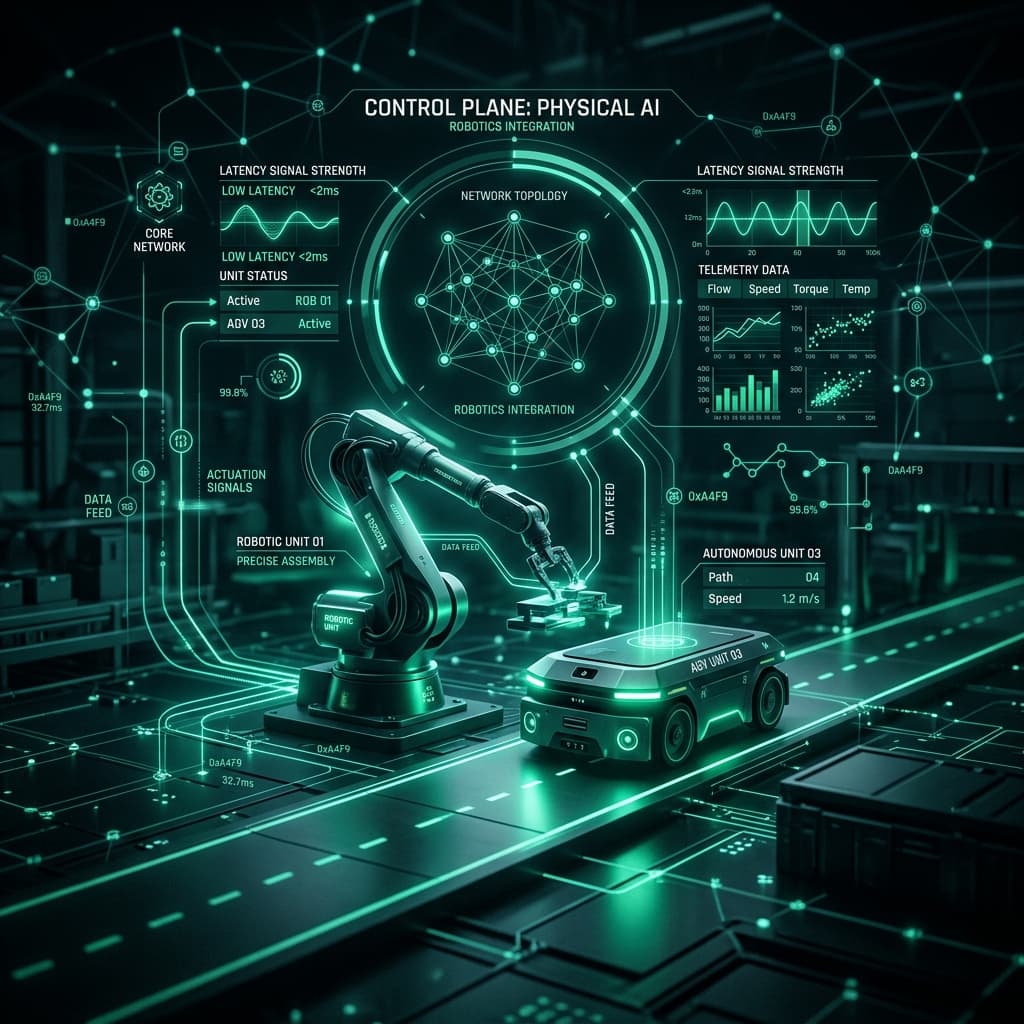
The Paradigm Shift of Physical AI and the Modern Control Plane
The landscape of robotics is undergoing a fundamental transformation as systems transition from rigidly programmed machines into adaptive, context-aware entities. Traditional automation relied on rule-based programming, limiting robotic arms and automated guided vehicles to highly structured environments with minimal spatial variability. The emergence of Physical AI represents a paradigm shift, defining intelligent systems that combine real-time perception, deep reasoning, and kinetic action to interact directly with the physical world through robotic embodiments. Rather than executing pre-calculated coordinates, modern robots utilize multi-modal Vision-Language-Action (VLA) foundation models to achieve zero-shot learning and real-time adaptation in unpredictable, dynamic processes.
This technological inflection is accelerated by advancements in edge-compute hardware. The NVIDIA Jetson Thor series modules, powered by the Blackwell GPU architecture, deliver up to 2070 TFLOPS of FP4 AI compute and 273 GB/s of memory bandwidth within a highly efficient 40–130 W power envelope. This high-performance hardware enables edge deployment of multi-billion-parameter VLA flow models like pi_0 and Octo. These models process continuous sensory feedback and output high-frequency, continuous trajectories for complex bimanual manipulations and mobile movements. Real-world operational implementations demonstrate the maturity of these architectures. For example, the orchestration of mobile systems, AI-based sorting mechanisms, and generative AI-guided manipulators across logistics networks has realized a 25% faster delivery cycle, a 25% boost in overall efficiency, and a 30% increase in skilled human-supervisory roles.
As these Physical AI systems scale from individual units into massive, distributed fleets, they require highly performant, secure, and low-latency control planes. For startup founders and technical leaders, building the web-based dashboards, telemetry interfaces, and human-in-the-loop verification layers that orchestrate these physical fleets is a critical engineering priority. Managing these complex systems requires a developer with expertise in both modern full-stack web architectures (specifically Next.js and the MERN stack) and structured project delivery methodologies to ship robust control systems on budget and on schedule.
1. High-Performance Communication: Bridging ROS2 with React and Next.js
At the hardware level, robots coordinate internally via the Robot Operating System (ROS2), which relies on highly optimized TCP/UDP sockets for node-to-node communication. Because modern web browsers cannot interact directly with raw network sockets, building an interactive cloud control plane requires a highly efficient bridging mechanism to translate ROS2 publication, subscription, service, and action nodes into browser-compatible web protocols.
Evaluating the primary communication frameworks is a critical step when designing a real-time web-control interface:
| Architecture | rosbridge_suite WebSocket | Custom FastAPI Bridge | Custom Flask Bridge |
|---|---|---|---|
| Latency | 5–15 ms | 2–5 ms (WebSocket) | 10–50 ms (REST-only baseline) |
| Throughput | Moderate (JSON serialization limits) | Maximum (Binary WebSockets) | Low-Medium (GIL-bound) |
| Security Support | Basic rosauth MAC token hashing | Advanced OAuth2, JWT, rate-limiting | Full Flask-Login integration |
| Graph Access | Unrestricted access to entire node graph | Secure, whitelisted topic routing | Manual multi-threaded mapping |
| Data Overhead | High (~30% inflation on Base64 images) | Low (Protocol Buffers, Msgpack) | Moderate (Text-heavy JSON limits) |
While rosbridge_suite combined with the roslibjs client library provides a fast setup path for developer diagnostic tools and Foxglove integrations, custom-built FastAPI bridges are preferred for production-grade telemetry dashboards. High-frequency camera streams (such as compressed MJPEG feeds) suffer from severe data inflation when encoded as Base64 JSON strings over standard websockets. A custom-built FastAPI bridge resolves this by utilizing binary WebSockets, streaming raw binary data directly to the client while running an asynchronous Python event loop alongside the rclpy executor to prevent application deadlocks.
In complex multi-agent setups (such as warehousing coordinates using Open-RMF), browser clients establish secure connections using WebSocket servers like SOSS. These connections use JSON Web Tokens (JWT) signed by centralized authentication providers to coordinate elevator overrides, automatic doors, and collision resolution rules across different robot brands. Additionally, integrating delta-based synchronization engines like MQTTSync prevents browser performance degradation by filtering out identical, repetitive sensor signals on the robot and transmitting only changed data to the rendering thread.
To prevent unauthorized remote overrides on public networks, security hardening must be applied to the server hosting the web bridge. Developers must isolate system-level commands to a dedicated, unprivileged deploy user on the VPS, using strict sudoers definitions to limit command access, and configure authorized key options to block unauthorized port forwarding.
2. Stateful Telemetry and Hydration: Zustand in Next.js App Router
When building reactive telemetry control panels in Next.js, managing high-frequency state updates—such as 50 Hz joint configurations, positional vectors, and lidar range sweeps—requires a highly performant, decoupled state manager. Standard state providers can cause performance issues if not carefully integrated with server-side rendering (SSR) environments.
Mitigating Cross-Request State Pollution
A primary risk in Next.js Server Component architectures is the accidental leak of runtime state across independent user requests. Because Node.js servers run stateful modules in a shared memory environment, instantiating a global, module-level state store (using Redux or Zustand as a standard singleton) causes state pollution across different users. One operator can potentially intercept the telemetry controls or sensitive environment credentials of another.
To eliminate this risk, state stores must be created dynamically per request and nested entirely within the React context hierarchy to prevent state leaks.
Resolving Client-Side Hydration Failures
Robotics control portals often persist local configurations (such as custom layout structures or map zoom preferences) on the client. However, accessing browser-only storage APIs like window.localStorage during Next.js server pre-rendering causes DOM discrepancies, triggering React hydration errors.
To ensure the server and client render identical layouts during the initial load, components must defer state-dependent client elements until the rehydration process completes. This is achieved using a React context provider combined with local storage rehydration.
To display this telemetry on the client without triggering server rendering mismatches, components defer their layout initialization using a hydrated state flag:
// src/components/telemetry-panel.tsx
'use client';

import { useState, useEffect } from 'react';
import { useTelemetryStore } from '@/store/telemetry';

export function TelemetryPanel() {
  const [isHydrated, setIsHydrated] = useState(false);
  const velocity = useTelemetryStore((state) => state.velocity);

  useEffect(() => {
    setIsHydrated(true);
  }, []);

  if (!isHydrated) {
    return <div className="animate-pulse h-48 bg-gray-200 dark:bg-gray-800 rounded-xl" />;
  }

  return (
    <div className="p-6 rounded-xl border border-black/10 dark:border-white/10 bg-white/5 backdrop-blur-md">
      <h3 className="text-sm font-semibold">Robot Velocity</h3>
      <p className="text-2xl font-bold font-mono">{velocity} m/s</p>
    </div>
  );
}
3. Infrastructure Economics: Vercel vs. Self-Hosted VPS
For startups operating Physical AI fleets, server runtime performance and cost predictability are key constraints. Robotics dashboards process heavy, continuous data payloads, which can run into significant overage charges on managed serverless platforms.
The True Cost of Managed Serverless Environments
Vercel Pro plans are affordable for early-stage development, but costs can rise quickly when processing high-frequency data streams. The "Vercel Tax" represents the premium paid for managed hosting compared to deploying on raw virtual machine infrastructures:
| Operational Vector | Vercel Pro Pricing Limits | Estimated Enterprise Overage Cost (Vercel) | Self-Hosted VPS Costs (e.g., Hetzner) |
|---|---|---|---|
| Team Seats | $20 / user / month | Linear scaling per operator seat | $0 (No seat-based licensing) |
| Data Outflow | 1 TB baseline included | $40 per 100 GB overage | $0 (20 TB included on standard plans) |
| Compute Run Limit | 1,000 serverless execution hours | $0.18 per GB-hour overage | $0 (Flat-rate CPU utilization) |
| Edge Routing | 1M edge middleware executions | $0.65 per million overage | $0 (Nginx/HAProxy open routing) |
| Image Assets | 5,000 optimized images | $5.00 per 1,000 overage | $0 (Local sharp-library execution) |
A startup with a 5-person engineering team monitoring 100 connected robots—generating 1.5 TB of data transfer and using 2,000 Serverless GB-hours for heavy data processing—can run into monthly costs exceeding $600 on Vercel. For a complete comparison, refer to our analysis on Next.js 16 Server Components: What Founders Need to Know About Hosting Costs.
Deploying the same Next.js application on a self-hosted Cloud VPS (such as Hetzner) via an open-source PaaS like Coolify reduces infrastructure costs to less than $20 a month. This provides flat-rate cost predictability, full root control over background runtimes, and local data residency.
Other cloud configurations offer different operational trade-offs for startups:
- Railway: Matches Vercel’s ease of use but implements a resource-based container model. This provides predictable billing and direct integration with dev engines, without serverless function timeouts.
- Cloudflare Workers (via OpenNext): Highly cost-effective and performant globally, but does not support a full Node.js runtime environment, which can limit complex local integrations.
Overcoming Build-Time Limitations and Server Action Caps
Building robust, high-payload applications in Next.js requires configuring build-time and runtime size limits. For example, uploading large multi-gigabyte log files (rosbag archives) via Next.js Server Actions can trigger a 413 Payload Too Large error due to Next.js’s default 1MB request cap.
Developers can resolve this by adjusting the configuration in next.config.ts:
// next.config.ts
const nextConfig = {
  experimental: {
    serverActions: {
      bodySizeLimit: '10mb',
    },
  },
};
export default nextConfig;
Similarly, API routes that stream detailed spatial maps or coordinate arrays may hit the default 4MB response limit. This limit can be adjusted or disabled inside the route configuration:
// app/api/map/route.ts
export const config = {
  api: {
    responseLimit: false,
  },
};
For workloads with larger file sizes, streaming uploads directly to secure S3 storage buckets or implementing client-side chunked assembly pipelines are recommended to keep servers lightweight and performant.
4. Front-End Budgets and Build-Time Optimizations in Next.js 16
In telemetry systems, UI lag can delay critical manual overrides. Performance optimization of the browser bundle is a key requirement for reliable operation.
Performance Diagnostics with Turbopack
Next.js 16 uses Turbopack as its default compiler, delivering up to 10x faster hot-module replacement and 5x faster production build times. This release also introduces an experimental, built-in Bundle Analyzer integrated with Turbopack's module graph, replacing the older Webpack bundle analyzer. By running:
npx next experimental-analyze
Developers can export an interactive treemap of both client and server bundles. This tool enables engineers to trace import paths across server-to-client boundaries, optimize code splitting, and replace heavy libraries with lighter alternatives.
For example, replacing a heavy utility like Moment.js with a modular library like date-fns reduces client-side bundle size significantly:
| Library Option | Gzip Compressed Bundle Size | Modular Tree-Shaking Support |
|---|---|---|
| Moment.js | 60+ kB | Monolithic import pattern (No tree-shaking) |
| date-fns | 13 kB | Fully modular (Imports named components only) |
| Day.js | 2 kB | Lightweight core with plug-in options |
Automating Performance Budgets in CI/CD
To prevent dependency bloat from degrading performance as the codebase grows, teams can integrate size-limit directly into their continuous integration workflows. The following configuration sets strict bundle budgets in package.json:
"size-limit": [
  {
    "path": ".next/static/chunks/**/*.js",
    "limit": "150 kB"
  }
]
Combining these limits with an automated CI configuration guarantees that every pull request undergoes strict testing and optimization before deployment:
# .github/workflows/performance-audit.yml
name: Performance Audit

on: [pull_request]

jobs:
  size:
    runs-on: ubuntu-latest
    steps:
      - name: Checkout Code
        uses: actions/checkout@v4

      - name: Install Dependencies
        run: npm ci

      - name: Build Application
        run: npm run build

      - name: Size Audit
        run: npx size-limit
Using this pipeline as a merge gate prevents performance regressions and keeps interface latency within safe operating limits.
5. Extreme Developer Velocity: TypeScript 7.0 (Project Corsa)
In complex, multi-package robotics repositories, developer iteration speed is often throttled by slow compiler type-checking. Large codebases with deeply nested schemas, VLA definitions, and simulated telemetry arrays can slow development feedback loops.
The Native Compiler Rewrite
TypeScript 7.0 (Project Corsa) addresses this by rewriting the compiler in Go, delivering 10x faster type checking compared to older versions. By porting the codebase rather than rewriting it from scratch, Microsoft has preserved identical type-checking semantics, ensuring safety for production environments.
The compiler leverages multi-core parallelization, running parsing and type-checking routines across independent threads. This architecture provides dramatic performance improvements across large enterprise codebases:
| Project Scale | Legacy Node-based tsc | Native Go-based tsgo (Parallel) | Performance Speedup |
|---|---|---|---|
| Small (10k LOC) | 3.4 seconds | 0.35 seconds | ~9.7x |
| Medium (100k LOC) | 14.8 seconds | 1.42 seconds | ~10.4x |
| Large (500k LOC) | 62.1 seconds | 5.84 seconds | ~10.6x |
For more details on migrating compiler pipelines, see our post on TypeScript 7.0 Go-Native Compiler: What SaaS Founders Need to Know.
Additionally, TypeScript 7.0 features a completely rebuilt watch mode powered by the Parcel file-watcher. This watcher avoids expensive filesystem polling, reducing CPU overhead and keeping development environments responsive.
Preparing for Strict-by-Default Compilation
While Project Corsa introduces significant performance gains, it also enforces strict compile-time defaults that can affect existing setups:
- Strict Mode Defaults: TypeScript 7.0 enables strict type-checking checks by default, which may surface hidden typing discrepancies in legacy files.
- The rootDir Resolution Shift: The
rootDiroption now defaults strictly to the directory containing the project’stsconfig.jsonfile. For setups where source code resides in nested directories (such assrc/), this must be explicitly configured. - The types Inclusion Shift: The standard
typesarray now defaults to an empty array. Ambient declarations from Node or testing libraries are no longer auto-included, requiring explicit declarations. - Dropped Legacy JSDoc Support: TypeScript 7.0 removes legacy compilation support for JSDoc annotations like
@enumand@constructor, which can flag errors in mixed JavaScript projects.
To transition safely, teams can deploy the @typescript/typescript6 compatibility package to run tsc6 (the legacy compiler) and tsgo (the native engine) in parallel within their pipelines, ensuring identical type-checking outputs before upgrading fully.
6. Next-Generation Agentic Workflows: Vercel AI SDK, MCP, and Orchestration
As robotics systems become more integrated with natural language interfaces, developers are deploying AI-driven agents that can monitor telemetry, analyze operational anomalies, and execute recovery actions.
Orchestrating Agentic Tool Calls
The Vercel AI SDK provides a unified interface for calling large language models and orchestrating tool-execution loops. The following diagram illustrates how an agent evaluates system status, triggers recovery tools, and confirms the resolution:
sequenceDiagram
    participant Agent as Agent Executor
    participant LLM as Language Model
    participant MCP as Robot Control API (MCP)

    Agent->>LLM: 1. Evaluate system status & joint angles
    LLM-->>Agent: 2. Request tool call: adjustJoint(jointId, angle)
    Agent->>MCP: 3. Invoke control API via MCP
    MCP-->>Agent: 4. Execution output: Joint successfully rotated
    Agent->>LLM: 5. Report success status
    LLM-->>Agent: 6. Formulate recovery confirmation response
By utilizing ToolLoopAgent and integrating with the Model Context Protocol (MCP), developers can build portable tool sets that are easily shared across different AI systems. This simplifies integration with file systems, databases, and remote API gateways.
Startups can build self-healing agentic loops by deploying API endpoints that parse incoming alerts, run diagnostic tools, and output structured operational data:
// app/api/agent/diagnostic/route.ts
import { NextResponse } from 'next/server';

export async function POST(req: Request) {
  try {
    const { robotId, errorCode, telemetrySummary } = await req.json();

    // Call diagnostic handler via MCP or LLM
    const diagnosis = await runMCPDiagnostic(robotId, errorCode, telemetrySummary);

    if (diagnosis.shouldHeal) {
      await executeHealRoutine(robotId, diagnosis.healAction);
    }

    return NextResponse.json({
      status: 'resolved',
      diagnosis: diagnosis.summary,
      actionTaken: diagnosis.healAction,
    });
  } catch (error: any) {
    return NextResponse.json({ error: error.message }, { status: 500 });
  }
}
For highly complex, stateful workflows that require granular human-in-the-loop approvals, persistent memory, and cyclic execution paths, developers typically look to LangGraph. LangGraph provides robust checkpointing and manual approval gates to ensure safe execution in high-stakes robotic environments.
7. Global Testbeds and Regulatory Sandboxes
Deploying Physical AI systems requires adhering to strict safety guidelines and navigating complex regulatory landscapes.
The Punggol Digital District Living Testbed
To bridge the gap between software simulation and physical operation, Singapore has established the Punggol Digital District (PDD) living testbed, a pioneering initiative led by IMDA, JTC, and SIT.
Historically, securing testing permits for autonomous systems in public spaces could take up to 18 months. The PDD testbed simplifies this process by serving as a pre-approved regulatory sandbox. Within this designated district, operators can run and test multi-brand autonomous vehicles on public pathways without filing individual exemption requests, reducing development cycles to a few months.
Navigating Robotic Safety Standards
To ensure safe coexistence with humans, robots in these testbeds must comply with international and local safety standards. System integrators must design control systems to adhere to these core standards:
- Personal Care and Mobile Servants (ISO 13482): Governs safety design and testing parameters for personal care and mobile servant robots in shared public spaces. Learn more at the official ISO 13482 standard documentation.
- Industrial Robotic Systems (SS ISO 10218): Sets strict design requirements for robotic systems integration on factory and sorting facility floors.
- Elevator and Building Interoperability (ELEVATE & Open-RMF): Standardizes how mobile robots interact with building infrastructure like lifts and automatic doors, ensuring safe operations in facilities management.
By validating systems inside interoperability sandboxes like ELEVATE (located at the BCA Braddell Campus), startups can verify their hardware and software integrations before scaling to larger commercial deployments.
8. Strategic Project Execution: Bridging Web and Kinetic Systems
For startup founders, navigating the intersection of hardware development and high-performance software requires structured, risk-aware execution. Building a complex robotics control plane requires a developer who can act as a technical leader and certified project manager, using structured methodologies to deliver reliable systems:
- Risk-Based Sprints: Break down development into iterations, isolating hardware-dependent services from core frontend development to prevent physical prototyping delays from stalling web development teams.
- Strict "Definition of Done" for Safety: Telemetry features must pass automated unit testing, bundle size limit checks, and end-to-end integration tests (using Jest and Playwright) before deployment.
- Incremental VPS Deployments: Minimize deployment risk by using secure, automated pipelines to push code incrementally to target staging environments. This approach allows for thorough real-world validation of new software features before deploying them to the active production fleet.
By combining modern web architectures with structured project management practices, technical leaders can build reliable, cost-effective, and secure control systems that power the expansion of Physical AI fleets.