Sustainable Supercomputing: The Energy Challenge of Modern AI

Written by
Bhalli B
Full-Stack Engineer & SaaS MVP Architect
Certified Full-Stack Developer & MVP Specialist · Lahore, Pakistan
Technical leaders can build sustainable AI applications by transitioning from brute-force compute scaling to a green full-stack architecture. This involves deploying high-efficiency hardware under strict power-usage metrics, employing algorithmic optimizations like 1.58-bit quantization, and implementing lightweight, stateless software designs in frameworks like Next.js. By combining direct liquid cooling, Go-native compilation, and edge-routed small language models, startups can reduce aggregate query energy by up to ninety percent, transforming the massive environmental debt of modern neural networks into an economically viable, low-carbon operational model.
Mitigating the High-TDP Silicon Bottleneck in Enterprise AI Infrastructures
The rapid adoption of generative artificial intelligence has fundamentally altered global energy consumption dynamics. While early-stage engineering debates focused primarily on the massive energy demands of training deep neural networks, operational realities indicate that the long-term environmental debt is driven heavily by continuous inference. Because inference scales directly with user adoption and runs continuously, it accounts for approximately two-thirds of all AI-related computational power consumed globally.
A standard search query in a traditional database environment consumes roughly 0.3 Wh of electrical energy. In contrast, a single generative model invocation using an LLM consumes between 2.9 and 5.0 Wh—representing a tenfold increase in energy requirements per transaction. Under continuous load from billions of global users, the cumulative grid strain becomes a critical systemic bottleneck for hosting providers and public utilities alike.
The Projections of AI Energy Demands
The structural surge in data center energy footprints is illustrated by the shifting baseline of global capacity demand. By 2026, the global data center energy demand is projected to exceed 1,000 TWh, which is equivalent to the entire annual electricity consumption of Japan. The vast majority of this increase is driven by high-performance accelerators with Thermal Design Powers (TDP) exceeding 1,000W per chip.
| Metric | 2023 Baseline | 2026 Status / 2030 Projections |
|---|---|---|
| Traditional Keyword Search Cost | 0.3 Wh | N/A |
| Generative AI / Search Energy Cost | 2.9 - 5.0 Wh | N/A |
| Global Data Center Demand | 460 TWh | 1,050 TWh (2026) |
| Inference Share of Compute | 60% | 66% - 80% (2026) |
| Average Rack Power Density | 5 - 10 kW | 100 - 140 kW (High-Density) |
| U.S. Data Center Electricity Share | 4% | 6% (2026) |
| Global Inference Capacity | 2 GW (2024) | 50 GW (2030 Project) |
This exponential increase highlights the Jevons Paradox. As software engineering teams make breakthroughs in efficiency—such as model pruning, ternary logic, and compilation optimizations—the marginal cost of generating an individual token drops. Instead of reducing total energy consumption, this cost reduction makes AI integration highly lucrative across a broader spectrum of trivial applications, thereby driving up aggregate token volume and total power grid utilization.
Thermal Density and the Shift to Direct Liquid Cooling
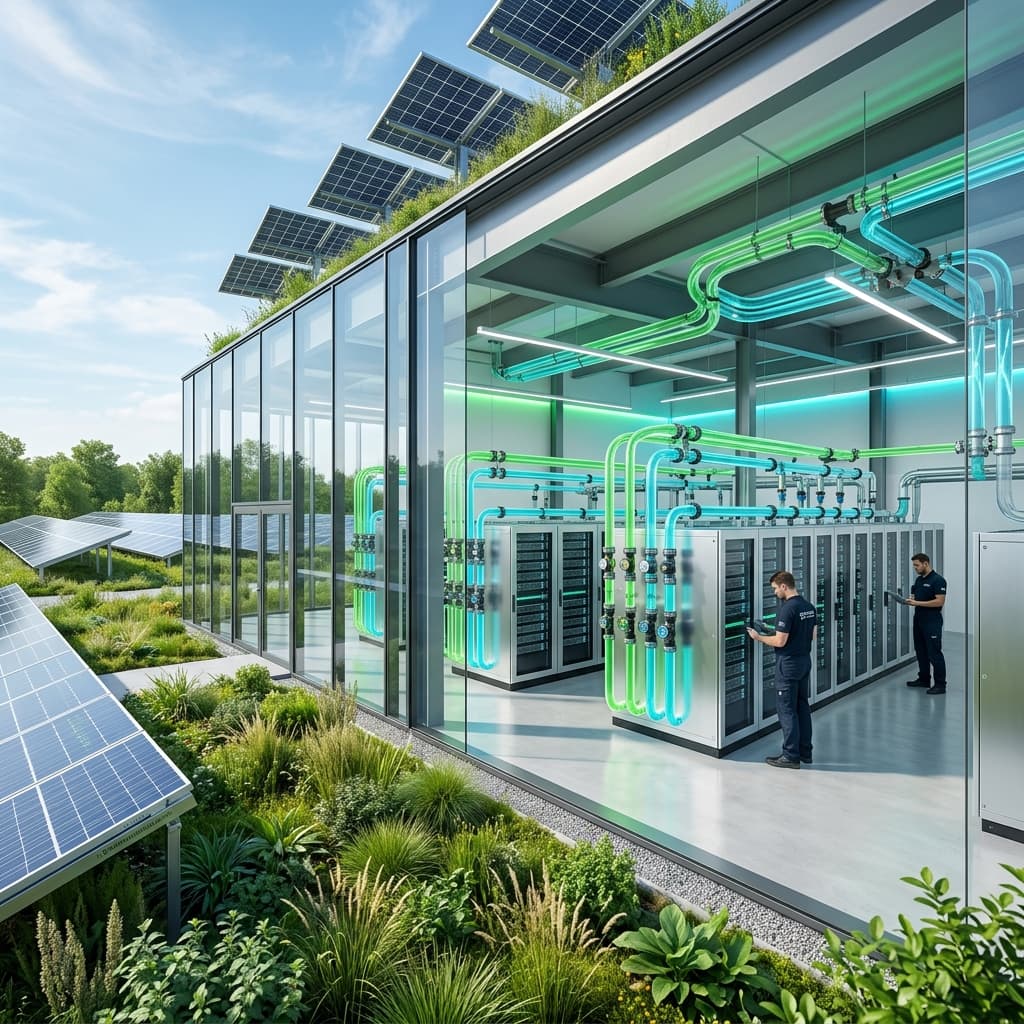
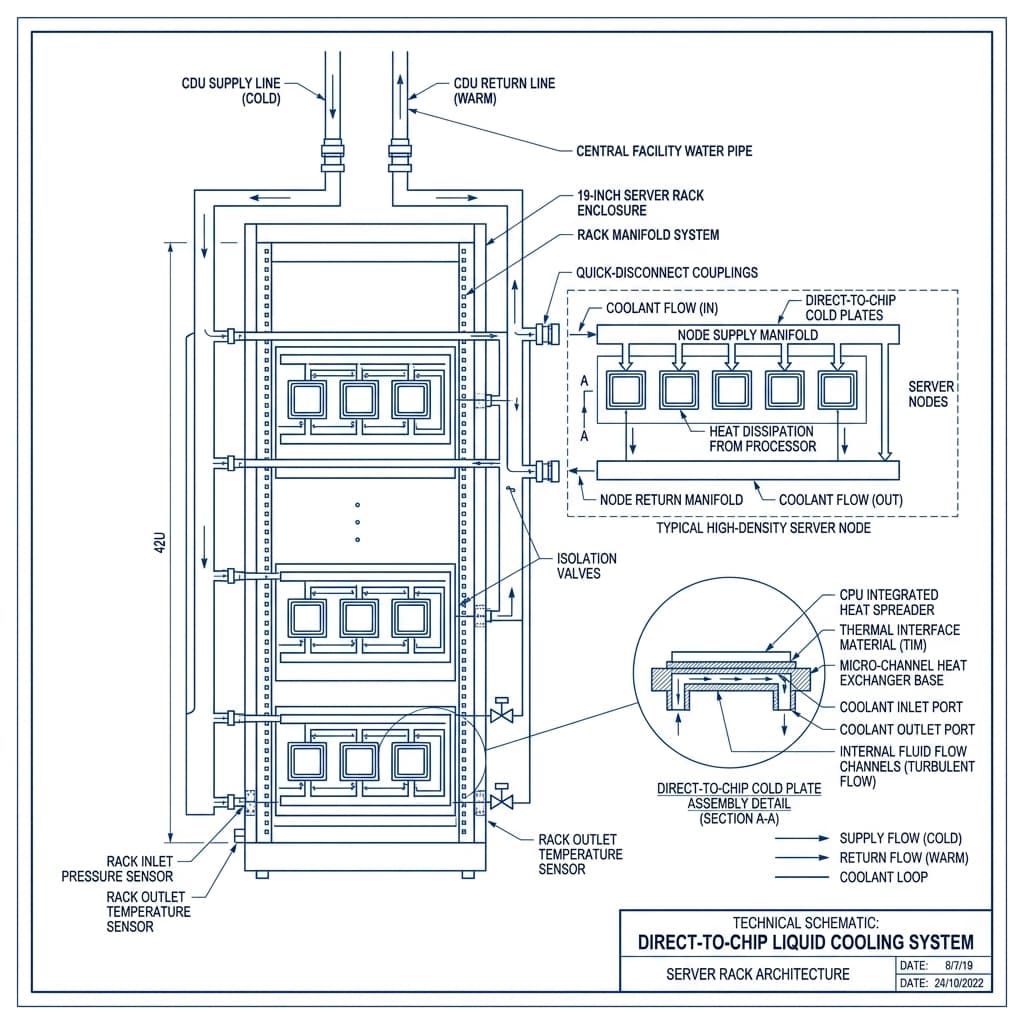
As silicon density approaches physical limits, the thermal design challenges of AI supercomputers become severe. The standard NVIDIA Blackwell B200 and B300 (Ultra) accelerators draw between 1,000W and 1,400W of TDP per chip. Traditional air-cooled server configurations are structurally incapable of cooling these environments, as air cooling can only manage a maximum density of approximately 15 kW per rack. High-performance AI server racks now demand between 100 and 140 kW per rack.
This has forced modern data centers to shift toward direct-to-chip liquid cooling and liquid immersion systems. To evaluate the efficiency of these facilities, operators rely on the Power Usage Effectiveness (PUE) metric, mathematically defined as:
Conventional air-cooled facilities run at PUE ratios between 1.30 and 1.60. This means that for every watt delivered to the processor, up to 0.60W is wasted on thermal management, power distribution, and auxiliary infrastructure. In contrast, modern facilities utilizing direct-to-chip liquid cooling achieve PUE ratios between 1.02 and 1.08, cutting auxiliary energy waste by over 80%.
Aligning Digital Infrastructure with Singapore Green Data Center Standards
Governments are implementing strict efficiency regulations to manage the environmental impact of artificial intelligence. The Republic of Singapore serves as a leading case study in proactive digital infrastructure governance.
The Operational Architecture of SS 564 and SS 697
Singapore's Infocomm Media Development Authority (IMDA) has established comprehensive sustainability requirements specifically tailored to data centers operating in equatorial regions. The Singapore Standard SS 564 (Green Data Centres) outlines a systematic environmental management framework modeled on ISO 50001. Operating on the Plan-Do-Check-Act (PDCA) methodology, SS 564 forces data center operators to continuously audit and optimize their mechanical, electrical, and IT infrastructure systems.
To supplement this framework, Singapore introduced the Tropical Data Centre Standard (SS 697:2023). Traditional Western data centers operate cold-aisle temperatures between 18°C and 22°C to prevent localized thermal hotspots. However, in tropical climates, maintaining these temperatures requires immense chiller power. SS 697 permits data centers to operate within a higher temperature window of 26°C to 35°C at 60% to 90% relative humidity. By validating that modern silicon can run safely at higher baseline operating temperatures, tropical facilities reduce overall cooling energy consumption by over 30%.
| Standard Code | Primary Focus Layer | Structural Mechanism | Target Metric / Benchmark |
|---|---|---|---|
| SS 564 | Energy & Environmental Management Systems | Plan-Do-Check-Act (PDCA) continuous improvement model | ISO 50001 Alignment, structural PUE tracking |
| SS 697:2023 | Tropical Data Centre cooling performance | High ambient temperature and humidity allowance | 26°C to 35°C operating range, 60% - 90% RH |
| SS 715:2025 | IT Infrastructure energy efficiency | Server virtualization, dynamic workload consolidation | ≥ 30% IT energy savings, US Energy Star alignment |
This regulatory push matches Singapore’s Digital Connectivity Blueprint, which aims to allocate at least 300 MW of additional capacity through green energy deployments. By partnering with industrial operators, the state accelerates hardware-level energy efficiency while maintaining strict grid stability.
Living Robotics Testbeds and Interoperability Sandboxes
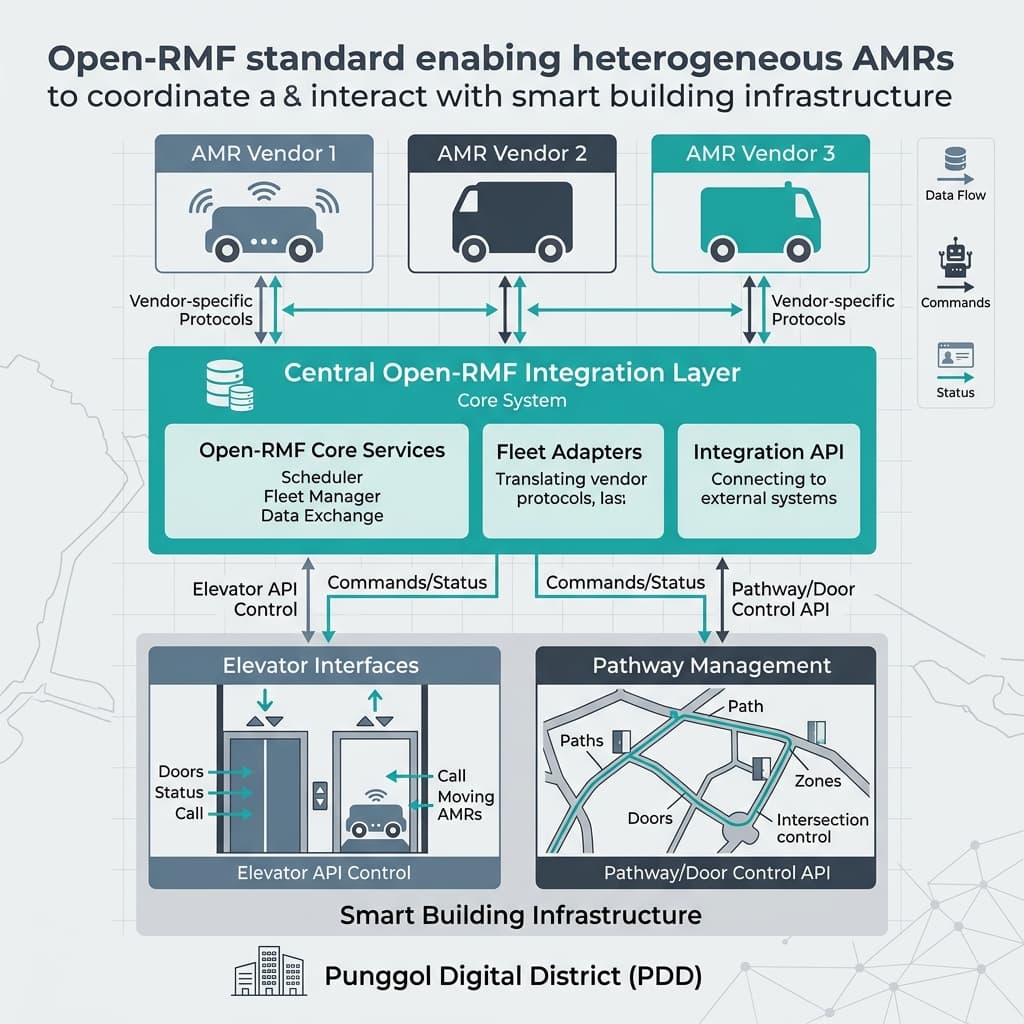
To transition these standards from academic literature into operational reality, Singapore has launched dedicated spatial testbeds. The Punggol Digital District (PDD) serves as Singapore's primary living testbed for physical and digital infrastructure integration. Developed through a partnership between IMDA, JTC, and the Singapore Institute of Technology (SIT), PDD integrates multi-operator autonomous robotics directly with building management systems via the Open-RMF (Robotics Middleware Framework) interoperability protocol. This framework ensures that physical AI systems—such as autonomous mobile delivery robots—coordinate paths, control building access, and utilize elevators efficiently, reducing unnecessary operational cycles.
Complementing this, the ELEVATE @ BCA Braddell Campus sandbox provides a highly specialized environment for validating how robots, elevators, and building management systems communicate over open APIs. This proactive synchronization reduces mechanical friction, optimizes battery recharge cycles, and lowers the cumulative carbon footprint of smart-city automation systems.
Decoupling from the Vercel Tax: The Economics of Next.js Self-Hosting vs Vercel
For startup founders and technical leaders, computational sustainability is deeply connected to financial survival. While Vercel provides a seamless developer experience for early-stage MVPs, scaling a high-traffic application can quickly trigger the "Vercel Tax".
Under Vercel Pro pricing models, bandwidth overages scale at $0.15 per GB once the initial 1 TB baseline is crossed, and edge middleware invocations are metered per million requests. A rapidly growing SaaS product with 500,000 monthly visitors can easily generate a Vercel bill exceeding 600 USD when factoring in heavy serverless execution, image optimizations, and edge processing.
Operational and Financial Cost Profiles
Understanding how compute, bandwidth, and team configurations scale across hosting platforms is essential for technical decision-making.
| Feature / Dimension | Vercel Pro Plan | Self-Hosted VPS (Hetzner / MassiveGRID) |
|---|---|---|
| Baseline Cost | $20 per user / month | $1.99 to $16.99 USD / month |
| Bandwidth Limits | 1 TB included, then $0.15/GB | 20 TB included (flat-rate) |
| Function Invocations | 1M included, then $0.60/million | Unlimited (limited only by CPU/RAM) |
| Image Optimization | 5,000 included, then $5.00/thousand | Unlimited (processed on-instance via sharp) |
| Cold Starts | Present (10s - 60s timeout limits) | Zero cold starts (always-on containers) |
| Setup Complexity | Zero-ops git push integration | Requires 4-8 hours setup (Coolify/Docker) |
For cost-conscious production workloads, self-hosting Next.js using Coolify on a flat-rate Hetzner or MassiveGRID VPS presents an alternative. This architecture bypasses serverless cold starts, unlocks unlimited Node.js background processes, and provides predictable flat-rate pricing.
However, the transition is not free; it introduces an upfront "self-hosting tax". Designing, securing, and maintaining custom CI/CD pipelines, automated testing, and diagnostic reporting requires roughly 4 to 8 initial engineering hours, followed by ongoing annual maintenance. Startup leaders must weigh these hours against their immediate burn rate to determine the optimal timing for infrastructure migration.
The Edge of Hybrid Containment
To optimize both computational footprints and hosting fees, startups can employ a hybrid approach. Trivial landing pages and marketing assets can remain on Vercel's free or baseline tiers to leverage global CDN networks, while computational logic, database connections, and background workers are isolated onto a dedicated VPS. This prevents minor traffic spikes from cascading into unexpected bills, ensuring both financial stability and optimal compute efficiency.
Implementing Continuous Performance Budgets in CI/CD Pipelines
A significant portion of modern computational waste occurs at the client boundary. Sending heavy JavaScript bundles to the browser triggers significant processing overhead, especially on low-power mobile devices. The browser must download, parse, compile, and execute the code, keeping the CPU core in a high-power state and directly consuming electrical energy.
To enforce front-end efficiency, teams must implement continuous performance budgets within their deployment workflows. The code block below provides an automated Next.js deployment configuration for GitHub Actions. It leverages actions/cache to persist the Next.js compilation artifacts and uses size-limit to reject pull requests that exceed established performance budgets.
name: Production Deployment and Performance Check

on:
  push:
    branches: [ main ]
  pull_request:
    branches: [ main ]

jobs:
  build-and-test:
    runs-on: ubuntu-latest
    steps:
      - name: Checkout repository source
        uses: actions/checkout@v4

      - name: Initialize Node.js environment
        uses: actions/setup-node@v4
        with:
          node-version: 20
          cache: 'npm'

      - name: Restore Next.js build cache
        uses: actions/cache@v4
        with:
          path: |
            ~/.npm
            ${{ github.workspace }}/.next/cache
          key: ${{ runner.os }}-nextjs-${{ hashFiles('**/package-lock.json') }}-${{ github.sha }}
          restore-keys: |
            ${{ runner.os }}-nextjs-${{ hashFiles('**/package-lock.json') }}-
            ${{ runner.os }}-nextjs-

      - name: Install dependencies cleanly
        run: npm ci

      - name: Run code quality linter
        run: npm run lint

      - name: Compile Next.js production build
        run: npm run build
        env:
          NEXT_TELEMETRY_DISABLED: 1

      - name: Enforce strict performance budgets
        uses: andresz1/size-limit-action@v2
        with:
          github_token: ${{ secrets.GITHUB_TOKEN }}
          skip_step: install
By caching the .next/cache directory, subsequent builds can skip compiling unchanged pages and components, reducing build times by up to 70%. This reduces compile time from several minutes to single-digit seconds, directly lowering the compute overhead of CI/CD runners.
Porting Pipelines to TypeScript 7.0: Maximizing Compilation Velocity with Project Corsa
One of the most effective ways to lower the carbon footprint of development operations is to optimize local and remote compilation pipelines. Microsoft's TypeScript 7.0 release—codenamed Project Corsa—implements a major performance upgrade by replacing the legacy JavaScript-based compiler with a Go-native implementation.
Reimplementing the tsc Engine
By porting the compiler structure file-by-file into Go, Microsoft has preserved identical type-checking semantics while unlocking native binary speeds and shared-memory parallelism. On large codebases, type-checking speeds are often roughly 10 times faster than prior versions.
| Repository | LOC Size | TypeScript 6.0 | TypeScript 7.0 (Go) | Speedup Factor |
|---|---|---|---|---|
| VS Code | 1.5M | 77.8 seconds | 7.5 seconds | 10.4x |
| Playwright | 356K | 11.1 seconds | 1.1 seconds | 10.1x |
| TypeORM | 270K | 17.5 seconds | 1.3 seconds | 13.5x |
| Sentry | N/A | 133.1 seconds | 16.3 seconds | 8.2x |
This performance upgrade reduces developers' local compile wait-times and significantly lowers the compute cycles consumed by cloud runners.
Managing tsconfig Breaking Changes
While Project Corsa maintains semantic parity, upgrading to TypeScript 7.0 introduces several default behavioral changes that teams must configure carefully:
- Default rootDir: The
rootDirparameter now defaults strictly to./. Projects wheretsconfig.jsonsits outside the source directory must explicitly maprootDirto prevent broken outputs. - Empty Types Array: The
typesparameter now defaults to an empty array. Ambient globals—such as those defined in@types/nodeor@types/jest—are no longer automatically included. Developers must list these explicitly in their configuration files to avoid compilation errors.
To run TypeScript 7.0 side-by-side with older versions for validation, teams can utilize the official compatibility package @typescript/typescript6, which exposes the legacy engine as tsc6 while letting the new Go-native binary use the primary tsc command.
Isolating State in Next.js App Router to Prevent Server-Side State Pollution
In high-concurrency Node.js environments, managing global application state requires strict isolation. A common mistake when using state management libraries like Zustand or Redux in Next.js App Router is declaring the store as a global singleton variable at the module level.
The Danger of Shared Module State
Because server-rendered applications process multiple concurrent requests on a single Node.js thread, a global singleton store will be shared across different user sessions. This can cause cross-request state pollution, leaking sensitive user data or AI contexts between requests.
To prevent leaks, developers must instantiate the state store dynamically within a custom React Context provider. This ensures that a new, isolated store instance is created per request, preventing cross-session pollution.
// store/use-app-store.ts
import { createStore } from 'zustand/vanilla';

export interface PromptState {
  promptInput: string;
  isGenerating: boolean;
  modelComplexity: 'simple' | 'complex';
}

export interface PromptActions {
  setPromptInput: (prompt: string) => void;
  setGenerating: (status: boolean) => void;
  setComplexity: (complexity: 'simple' | 'complex') => void;
}

export type PromptStore = PromptState & PromptActions;

export const createPromptStore = (initialState?: Partial<PromptState>) => {
  return createStore<PromptStore>((set) => ({
    promptInput: '',
    isGenerating: false,
    modelComplexity: 'simple',
    ...initialState,
    setPromptInput: (prompt) => set({ promptInput: prompt }),
    setGenerating: (status) => set({ isGenerating: status }),
    setComplexity: (complexity) => set({ modelComplexity: complexity }),
  }));
};
This store is managed by a custom StoreProvider component that uses a useRef to maintain the isolated store reference across render cycles:
// store/store-provider.tsx
'use client';

import { createContext, useContext, useRef, ReactNode } from 'react';
import { useStore as useZustandStore } from 'zustand';
import { createPromptStore, PromptStore } from './use-app-store';

const StoreContext = createContext<ReturnType<typeof createPromptStore> | null>(null);

export interface StoreProviderProps {
  children: ReactNode;
  initialState?: Partial<PromptStore>;
}

export function StoreProvider({ children, initialState }: StoreProviderProps) {
  const storeRef = useRef<ReturnType<typeof createPromptStore> | null>(null);

  if (!storeRef.current) {
    storeRef.current = createPromptStore(initialState);
  }

  return (
    <StoreContext.Provider value={storeRef.current}>
      {children}
    </StoreContext.Provider>
  );
}

export const useStoreSelector = <T,>(selector: (store: PromptStore) => T): T => {
  const storeContext = useContext(StoreContext);
  if (!storeContext) {
    throw new Error('useStoreSelector must be used within a StoreProvider');
  }
  return useZustandStore(storeContext, selector);
};
Mitigating Server Runaway Loops in Agentic Workflows
As artificial intelligence systems transition from passive text generation to autonomous agents, developers must design robust boundaries for agentic execution. AI agents naturally operate in loops: interpreting input, selecting tools, executing operations, and analyzing the results.
If a tool fails, returns invalid formatting, or encounters an API rate-limit, the agent may enter an infinite self-healing loop. This can quickly exhaust API limits, consume high-cost serverless execution budgets, and waste massive amounts of computational energy.
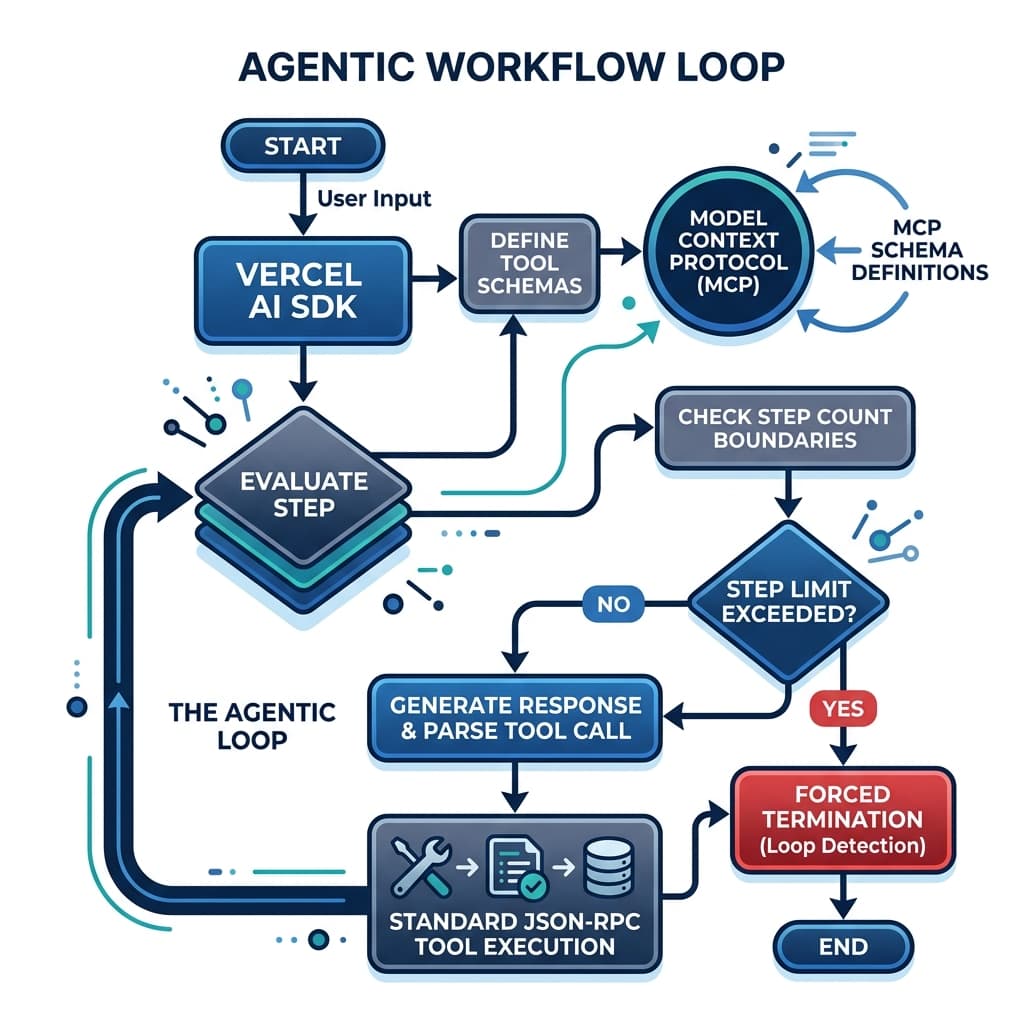
To mitigate runaway loops, teams should employ two structural safeguards:
- Enforced Step Count Boundaries: Utilizing the
stopWhenproperty alongsidestepCountIslimits the agent's reasoning cycles to a predefined maximum threshold. - Model Context Protocol Integration: Implementing the Model Context Protocol (MCP) decouples tool definitions and execution into stateless, standard service endpoints communicating via JSON-RPC. This prevents the overhead of dynamic code compilation and allows the model to scale its tooling safely.
Technical Recommendations for Low-Carbon Systems
To build sustainable, high-performance web applications, engineering teams should implement the following strategic practices:
- Implement Algorithmic Delegation: Integrate edge-based routing middleware to resolve simple, structured queries using optimized Small Language Models (SLMs) before escalating complex logic to high-TDP supercomputing clusters.
- Optimize Front-End Delivery: Enforce hard performance budgets in CI/CD using tools like
size-limitto prevent the delivery of bloated client-side JavaScript packages, directly reducing client execution energy. - Persist Pipeline Cache Layers: Configure the preservation of
.next/cacheand package stores across CI runs to minimize compilation execution times and lower the computational carbon footprint of deployment pipelines. - Isolate Component State: Enforce context-driven, per-request state management using Zustand to prevent memory leaks and state pollution across concurrent server-rendered user sessions.
- Control Agentic Execution: Bound all iterative LLM interactions with strict execution step constraints, and leverage standard, stateless interfaces like the Model Context Protocol to manage tool integration.
By coordinating these optimizations across the full computing lifecycle, modern organizations can build high-performance AI systems that scale efficiently, sustainably, and cost-effectively.
For technical leaders and startup founders looking to architect high-performance, energy-efficient MVPs, consulting and development services are available. Get in touch to schedule a technical discovery session or subscribe to the weekly development newsletter.